
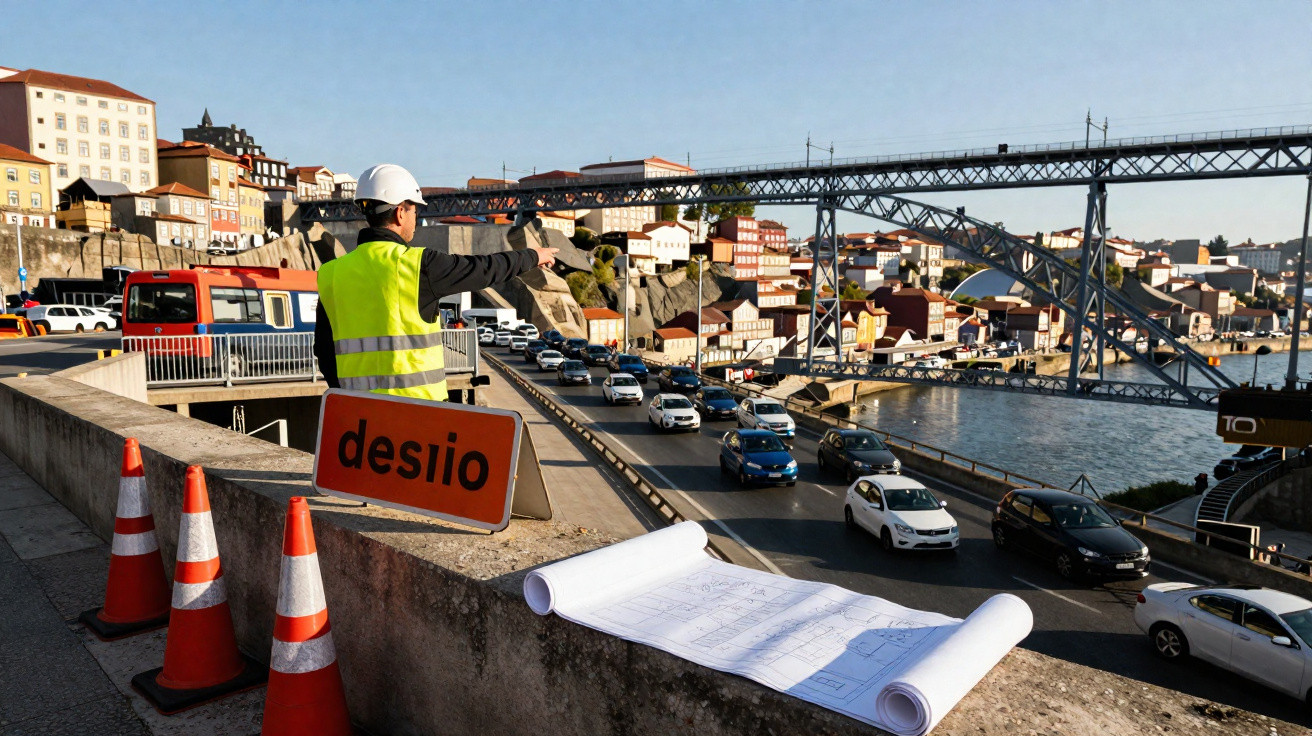
The Stone Quay Viaduct in Massarelos, Porto, will be subject to traffic restrictions for 10 months while rehabilitation works are carried out.
Tender launched by Go Porto
The municipal company Go Porto has opened a tender for the contract, with a base price of €2.25 million, to which VAT will be added at the prevailing rate. The project does not receive any European funding.
The tender documents state that the contract has an execution period of 300 days, and bids must be submitted by the 15th.
Stone Quay Viaduct rehabilitation works
According to the specification, the intervention involves a full refurbishment of the viaduct, covering the road surface, pavements, retaining walls and the remaining parts of the crossing structure.
"The project follows the defects identified during a technical inspection of the viaduct, with the main aim of strengthening the safety and durability of this asset," Go Porto explains, noting that the crossing was built as part of the riverside regeneration for the European Capital of Culture in 2001. "This operation will reduce future maintenance needs and extend the structure’s service life," it adds.
"The works are intended to deliver an overall rehabilitation of the structure and strengthen the quay, while also improving the surrounding elements. The programme will also ensure the cleaning and treatment of the piers, the deck and the lateral walkways, as well as the targeted replacement of metal components showing excessive signs of corrosion. In addition, the bearing components are to be painted and the metal support structure for the deck will be repaired," the municipal company details.
The works will also include a review of the rainwater drainage network and the electrical infrastructure, including "updating the viaduct lighting system".
"Finally, the project includes repaving the carriageway, cleaning the expansion joints, painting metal elements and removing unwanted vegetation. The intervention will also ensure compliance with current technical and regulatory requirements, strengthening the structure’s overall performance under today’s demands," Go Porto concludes.
Traffic arrangements and required consents
The specification warns that works - "namely the repair of cornices, guardrails, metal walkways, safety barriers and surfacing" - will require traffic management measures, including taking one of the two traffic lanes out of service.
The public tender file sets out two alternative approaches for these periods. The first would allow two-way traffic to share the remaining open lane (over a 340-metre stretch), controlled by traffic lights. "Eastbound / westbound traffic flow may be significantly constrained by the presence of the STCP stop at the start of the works area," the documents caution.
The second approach would route eastbound/westbound traffic along Stone Quay. "This solution requires the construction of temporary ramps (with a gentle gradient) at both ends, the removal of granite bollards and directional vertical signage, and the protection of granite-sett paving (which is probably not designed to withstand heavy loads)," the documents state. "This option would also potentially require the removal of outdoor terraces and a ban on parking along Stone Quay, with that prohibition needing permanent enforcement by the police," they add.
The specification also refers to the possibility of using the viaduct’s remaining lane in the city centre–Foz direction and diverting the opposite direction upstream via Restauração Street back towards the city centre.
Because the works will take place in a sensitive area, the contract is dependent on obtaining opinions from several bodies: the Directorate-General for Cultural Heritage, the National Civil Aviation Authority, the Douro, Leixões and Viana do Castelo Ports Administration, the Portuguese Environment Agency / Northern Regional Hydrographic Administration, and Porto Water and Energy.





Comments
No comments yet. Be the first to comment!
Leave a Comment