
That high, sharp squeak underfoot can take a peaceful evening and turn it into a steady irritation that gradually frays your patience.
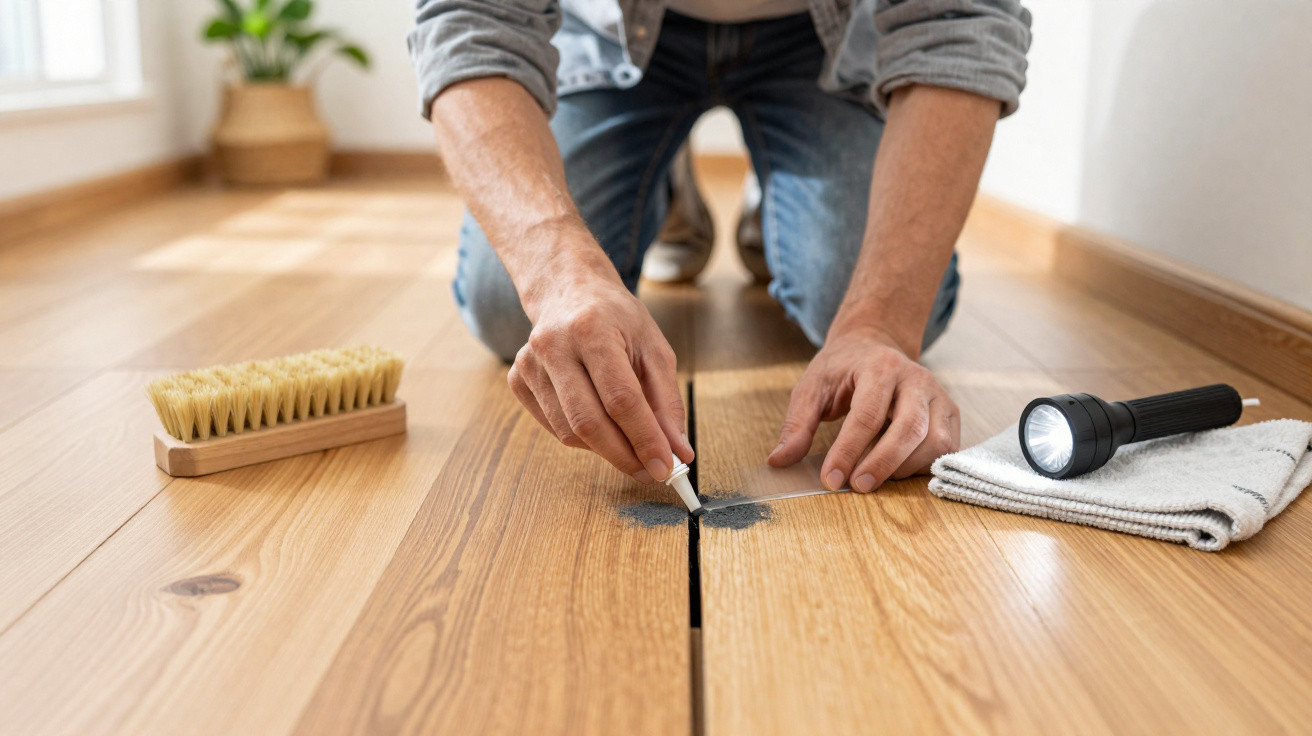
Increasingly, householders are dealing with it themselves and avoiding costly renovation quotes by using a simple, time-tested idea: injecting powdered graphite directly into the joints of a noisy wooden floor.
Why squeaky floors are suddenly back in the spotlight
Wooden floors are fashionable again in houses and flats across the UK and the United States. Estate agents describe them as “original features”. Buyers hear “character”. Then, not long after moving in, they hear the real soundtrack: a relentless run of squeaks.
In most cases, that noise is not a sign the floor is about to fail. It is a sign something is moving. Timber expands and contracts as temperature and humidity shift. Boards can rub on neighbouring boards, or against nails and screws, and the resulting friction becomes sound. Older joists can flex underfoot. In lighter modern construction, the effect can be amplified because the floor can behave like a drum skin.
"Most squeaks come from tiny movements between wood surfaces, not from anything dangerously loose."
The traditional remedies are often disruptive: pulling up carpets, driving additional screws into joists, or even replacing sections of flooring. That brings dust, noise and, if a contractor is lifting boards for the day, a bill that can easily run into the thousands. It is easy to see why quick, precise fixes are gaining traction on DIY forums and social feeds.
How powdered graphite calms a noisy floor
Graphite may sound technical, but it is very familiar: it is what sits inside a pencil. It is carbon arranged in thin, slippery layers. Because those layers slide over one another so readily, graphite works extremely well as a dry lubricant.
When used on squeaky floor joints, powdered graphite works its way into the tiny gaps and contact points between boards and fixings. Instead of wood scraping on metal, or planks chattering against one another, the surfaces move over a fine graphite film.
"Graphite does two crucial jobs at once: it reduces friction and fills micro-gaps where noise is born."
The “injection” idea is straightforward. Rather than wiping something over the surface and hoping it seeps down, you deliver the powder directly into the troublesome points: between tongue-and-groove boards, around nail shanks, or via small pilot holes drilled specifically for that purpose.
Graphite vs. oil and wax: why dry wins
- Graphite is a dry powder, so it is far less likely to hold on to dust and grit.
- It is less prone to staining timber than many oils and greases.
- It copes with temperature swings without becoming tacky or brittle.
- It can reach very tight voids that wax blocks or thicker sprays cannot fully get into.
A general-purpose oil spray in the cracks can quieten things briefly, but it may travel into subfloor materials, interfere with adhesives, and leave dark marks on finished surfaces. A dry lubricating powder avoids those problems.
Step-by-step: how a typical graphite injection works
You usually do not need an engineer for this. If you work carefully and methodically, many squeaks can be reduced or eliminated in an afternoon. The main point is to tackle the floor in stages, rather than dumping powder everywhere and hoping it lands in the right places.
1. Track down the exact squeak
Choose a quiet time and take your shoes off. Move slowly across the area, shifting your weight onto one foot at a time. Mark each noisy point with decorator’s tape or a pencil. Accuracy matters here: the goal is to identify the specific board and the precise edge that is most vocal.
Press down with your heel or the palm of your hand and check for movement. If the floor drops by several millimetres, or you can see a board lifting, you may need structural fixing as well as lubrication. If the movement is small and the sound is a higher-pitched chirp, graphite alone is often enough.
2. Expose the gaps gently
Remove dust and grit from the joints with a vacuum. Fine debris can prevent the powder from reaching the contact points where the sound is produced. Use a narrow attachment or a soft brush so you do not scuff the finish.
With tongue-and-groove flooring, look for hairline seams where the squeak appears to start. On older nailed boards, pay attention to tiny rings of space around nail heads. These spots are ideal candidates for injection.
3. Apply graphite with control
Powdered graphite is often sold in squeeze tubes or small bottles fitted with a narrow nozzle. That packaging is useful: it lets you place a small, controlled puff exactly where it is needed.
| Location | How to apply graphite | Extra tip |
|---|---|---|
| Between floorboards | Squeeze a fine line of powder along the joint | Use a thin plastic card to push it further in |
| Around nail heads | Lightly dust the area, then tap gently with a punch | The movement helps work powder down the shank |
| Hidden under carpet | Lift the edge and puff powder along board edges | Mark treated points before laying the carpet back |
Start with a small amount. You can add more, but too much can transfer onto socks or show up as grey residue along the seams. After each application, walk across the spot and listen. Often the reduction in friction is noticeable within seconds.
4. Encourage the powder into place
If graphite sits only on the surface, it will not do much; it needs to settle into micro-gaps. A few simple actions can help it bed in:
- Walk back and forth along the squeaky line with firm, even steps.
- Tap near the joint with a rubber mallet to promote slight movement.
- Shift your weight from heel to toe to flex the board and draw the powder in.
Many people find that a persistent squeak fades first and then stops entirely after two or three passes. If the sound does not change at all, the source may be deeper, within the subfloor or joists.
"A good rule of thumb: if you can see the joint move, graphite can usually help; if only the whole floor bounces, you likely need screws."
Where powdered graphite works best - and where it does not
Graphite injection is particularly effective in certain settings, especially older properties where you want the least possible disruption. However, it is not a universal cure. Spending a moment assessing the floor first can prevent wasted effort.
Best use cases
- Original hardwood floors with minor squeaks along board edges.
- Top-floor flats where soundproofing work would be awkward and expensive.
- Homes with finished ceilings below, where reaching joists from underneath is impractical.
- Rental properties where the landlord is happy with low-impact maintenance but not major building work.
In situations like these, treating the noise from above-without cutting, without adding new screws, and without leaving obvious changes-can be a significant advantage.
Situations that call for more than powder
If boards are significantly warped, or nails have worked loose from the joists, the noise is only one symptom. Graphite injection may reduce the sound, but the movement will still be there. You may need a carpenter or a structural check if you notice:
- Deep, low creaks paired with visible bounce across an entire section.
- Cracks in the plaster below that align with the noisy area.
- Boards that clearly lift at one end when you step on the other.
- Areas near bathrooms or kitchens where water damage is plausible.
Many contractors now combine approaches: graphite (or another dry lubricant) to deal with surface rubbing, alongside specialist screws that pull the subfloor and joists together from above. This keeps disturbance down while improving long-term results.
Safety, side effects and small risks to consider
Powdered graphite is commonly used in locks, automotive tasks and engineering, so it is well proven. Even so, using any fine powder indoors warrants a little care.
- Wear a simple dust mask if you are covering a large area in one session.
- Cover nearby rugs and soft furnishings with sheets or newspaper.
- Keep pets and young children out until you have vacuumed up any residue.
- Do not combine graphite with oil-based products, which can turn into a sticky black paste.
Because graphite is dark, applying too much can leave visible grey lines on pale, unfinished timber. Most pre-finished floors disguise it well, particularly once any loose powder is vacuumed away. It is sensible to test a small corner before treating a hallway or sitting room.
Why this “small fix” appeals in a tight housing market
As mortgage costs rise and many households postpone bigger refurbishment projects, attention has moved to manageable improvements that noticeably affect day-to-day living without major spend. A squeaky floor fits neatly into that group: not usually hazardous, but endlessly irritating.
"Silencing a hallway that wakes a baby or an early-rising partner changes the feel of a home far more than its resale value."
Retailers report consistent demand for small tubes of graphite in DIY-shop aisles that were once dominated by power tools and paint. It costs less than a takeaway, yet it can remove a noise you might notice dozens of times each day. That balance of low price and high impact explains much of the growing interest.
There is a psychological element as well. Sorting a squeak yourself can feel like a rare, clear success at home: you hear the “before”, you do the job, and then you hear the “after”-a quiet, satisfying silence. That immediate feedback often encourages people to tackle other small repairs they have been delaying.
Thinking ahead: how to prevent future squeaks
Once the boards settle down, it is natural to want to keep them that way. Prevention here is more about managing conditions than buying more products.
Timber tends to move most when humidity swings sharply between seasons. A modest dehumidifier in a damp basement flat, or a small humidifier in a very dry, heated loft, can reduce those fluctuations. More stable air means less expansion and contraction, which helps joints stay tighter and quieter.
Everyday behaviour helps too. Dragging heavy furniture across bare boards can twist fixings and open tiny gaps. Felt pads under legs, and lifting instead of pushing when you can, protects both the finish and the structure. When tradespeople lift boards for wiring or plumbing, asking them to re-fix the boards properly before closing up can prevent squeaks from appearing months later.
The graphite method sits within that wider approach as one targeted tool: accurate, inexpensive and reversible. If boards later need lifting for larger work, the powder can be vacuumed out. It does not tie you into a bigger system or hide what is happening beneath the surface. For many households living with the constant noise of a restless floor, that balance of effectiveness and restraint is precisely the appeal.




Comments
No comments yet. Be the first to comment!
Leave a Comment