
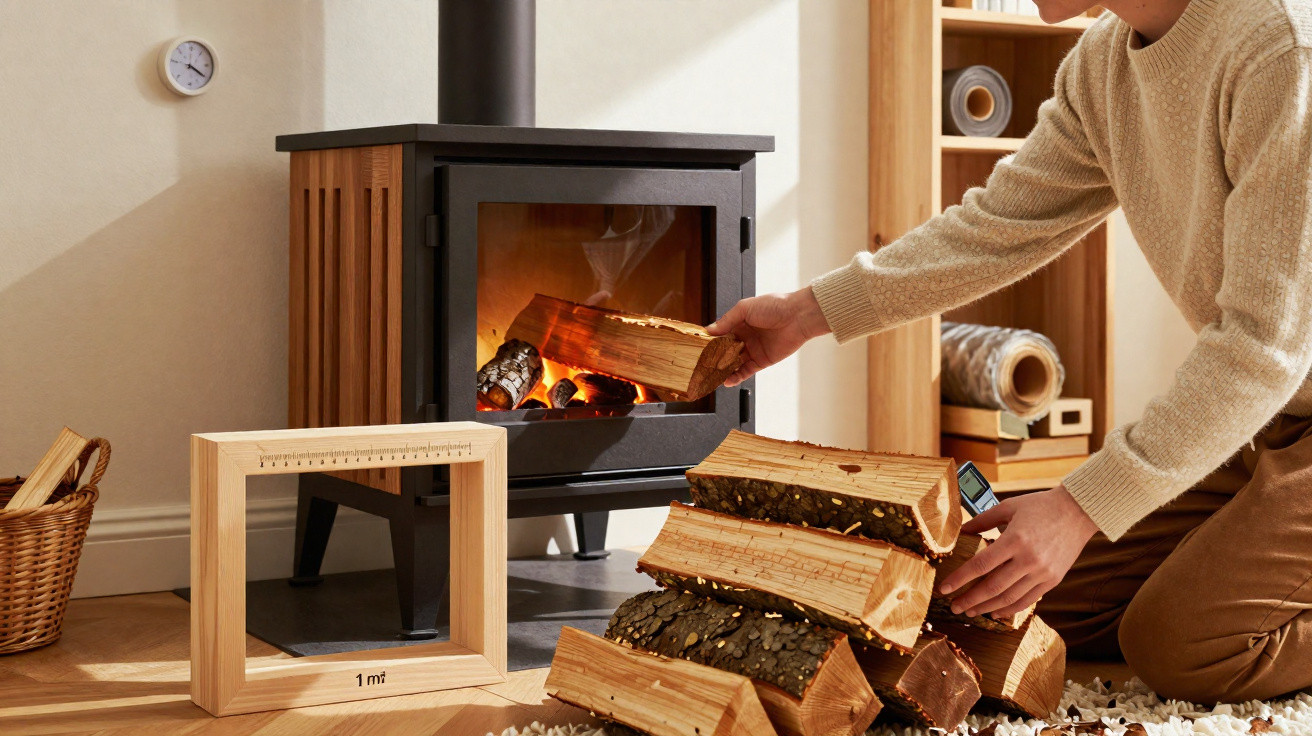
More households across Europe and North America are now turning to logs as either their primary way to heat the home, or as a reliable back-up. As the first frosts approach, the same practical question comes up: how much wood is actually needed to keep an 80 to 120 m² home comfortable through the whole winter, without running short by February?
Why the same house can burn very different amounts of wood
It is perfectly possible for two properties with the same floor area to get through vastly different volumes of firewood - sometimes one winter requiring twice as much as another. That difference is seldom down to luck. More often, it reflects a combination of insulation standards, local climate, day-to-day heating behaviour, and (frequently overlooked) how efficient the stove or fireplace really is.
For a typical 80 to 120 m² home, seasonal needs usually range from about 4 to 10 cubic metres of wood, depending on how well the home and the stove perform.
The role of floor area: 80, 100 or 120 m² is not the whole story
Floor area provides only a first, broad indication of likely demand. Warming 120 m² generally takes more energy than 80 m², but the relationship is not straightforward. A compact 80 m² bungalow with significant heat loss through large windows can end up using nearly as much wood as a well-insulated 120 m² home running a modern stove.
As a rough guide in a temperate climate:
- 80 m², good insulation, efficient stove: roughly 3 to 5 m³
- 100 m², average insulation, efficient stove: roughly 4 to 7 m³
- 120 m², weaker insulation or outdated system: often 7 to 10 m³
In colder areas these ranges move upwards; in milder coastal or southern locations they tend to drop.
Insulation: the “hidden” log saver
Insulation often matters more than the home’s size. Heat can pour out through under-insulated roofs, walls and floors, as well as old windows. Every draught and weak spot means the appliance has to work harder - and you end up burning more wood to keep temperatures steady.
Improving attic insulation and sealing major air leaks can cut wood use by 20 to 40% in some homes, without changing the stove.
In real terms, a 100 m² property with strong insulation and a decent appliance might need 4 to 6 cubic metres over a winter. The same-sized home with thin loft insulation, single glazing and noticeable draughts could require 8 or more, even if the climate is identical.
How the heating system changes everything
The difference in performance between an open fireplace and a contemporary wood-burning stove is enormous. The efficiency rating - often tucked away in the handbook - indicates how much of the wood’s energy ends up as useful heat in the room.
| Type of appliance | Typical efficiency | Wood for ~100 m² per winter* |
|---|---|---|
| Modern wood stove | 75–85% | 4–6 m³ |
| Insert / closed fireplace | 65–75% | 6–8 m³ |
| Open fireplace | 10–20% | 12–15 m³ |
*Ranges assume a temperate climate and average insulation.
With an open fire, a large share of the heat disappears straight up the chimney. While it can look appealing, it quickly drives up the amount of wood you need. Inserts and stoves - particularly newer models certified in Europe or North America - typically burn more cleanly and extract far more heat from each log.
Real-world scenarios for 80 to 120 m² homes
To put the figures into everyday context, these are common set-ups many households are dealing with:
- 80 m², poor insulation, open fireplace: households often need 10 to 12 m³, sometimes more during long cold spells.
- 100 m², good insulation, modern stove: most seasons fall between 4 and 6 m³.
- 120 m², average insulation, insert stove: owners usually report 7 to 9 m³ per winter.
- 120 m², strong insulation, efficient stove: 5 to 7 m³ can be enough, even in relatively cold regions.
Before buying an extra load, check how much you burned the previous winter, then compare insulation and weather conditions year on year rather than relying only on surface area.
Wood species and moisture: not all logs are equal
A stack of logs measured by volume alone can be misleading: two piles of the same size can produce very different heat output. The key variables are the timber species and the moisture level, which together determine how many useful kWh you actually get.
Hardwood vs softwood: what to choose for winter heat
Heavier hardwoods typically burn for longer and provide a more even, steady heat. For primary winter heating, many suppliers and stove manufacturers commonly recommend:
- Oak
- Beech
- Hornbeam
- Ash
These options generally offer a higher calorific value per cubic metre than lighter softwoods such as spruce or pine. Softwoods still have their place for kindling or quick bursts of warmth, but if you rely on them alone you will usually need a larger overall volume.
Why moisture content can double your consumption
Newly cut wood can hold 40 to 60% water. When you burn it, a significant amount of energy is wasted boiling off moisture rather than heating your rooms. It can also darken the stove glass, increase creosote build-up in the flue, and produce more smoke.
Seasoned wood with less than 20% moisture can deliver almost twice as much usable heat as freshly cut green wood of the same volume.
In many cases, proper drying takes 18 to 24 months in a well-ventilated log store, depending on the species and local conditions. An inexpensive moisture meter provides a quick check and can help you avoid paying full price for damp logs.
Storing and managing your winter wood stock
Storing firewood properly helps protect the money you spend on it. If wood is stacked badly - sitting on damp ground and left open to rain - it can lose a large share of its usable energy value within a single season.
Basic rules for a healthy woodpile
- Lift logs off the ground using pallets or timber beams.
- Leave space for air to move between rows rather than packing logs too tightly.
- Cover the top to keep rain off, while keeping the sides open for ventilation.
- If you can, choose a north- or east-facing position to reduce repeated soaking from driving rain.
- Bring a few days’ worth of logs indoors so they can finish drying before you burn them.
Households that run a two-year rotation - burning the pile that was stacked two summers earlier - often find consumption becomes more consistent and the stove is easier to run.
How to estimate your own needs before winter
Rather than copying a neighbour’s figures, it is usually more accurate to create a simple forecast for your own home. A straightforward estimate blends three factors: floor area, insulation level, and the type of appliance used.
A quick method to size your order
In a temperate climate, you can begin with a “base” reference for an average 100 m² home: around 6 m³ when using a decent insert. From there, adjust as follows:
- Surface: add or subtract about 1 m³ for each 20 m² above or below 100 m².
- Insulation: remove 1 to 2 m³ if the property has high-performance insulation; add 1 to 3 m³ if it suffers from major heat loss.
- Appliance: subtract around 1 m³ for a very efficient modern stove; add 3 to 6 m³ for an open fireplace.
Using this approach, a 90 m² well-insulated home with a recent stove could come out at about 4 m³. A 120 m² older property with an insert and average insulation might be nearer 8 or 9 m³ when winters are tougher than usual.
What many households forget when calculating firewood
People new to wood heating often misjudge the impact of everyday routines on consumption. Running the heat around the clock, leaving internal doors open, or setting the home to 22 °C rather than 19 °C can easily double the volume burned.
Many households also treat logs as a “comfort” add-on to electric or gas heating. This hybrid approach can reduce the main energy bill, but it also makes yearly wood demand less predictable. In a mild season, a 100 m² home might use only 2 to 3 m³ as back-up; in a prolonged cold winter, that can rise to 5 m³ even if insulation has not changed.
Extra factors to consider before committing to wood heat
If you plan purely by volume, you can miss several practical risks and advantages that come with heavy wood use. Regular chimney sweeping - at least once each year - lowers the risk of chimney fires, particularly for households burning large quantities or occasionally using slightly damp logs.
Air quality is another consideration. Even modern stoves release fine particles, although far fewer than older appliances. Using dry hardwood, lighting from the top, and avoiding slow, smouldering fires can reduce emissions significantly. In built-up urban areas, that factor can influence whether households choose to rely entirely on wood or keep it as a secondary heat source.
Finally, there is the cash flow question. Purchasing the whole winter’s supply in one go often brings a better price per cubic metre, but it also ties up money at a time when other winter costs increase. Some households now buy in stages: they start with a simple estimate based on previous winters, then add a small buffer load mid-season if forecasts suggest a cold snap. This gradual approach can help avoid both running out and being left with an oversized pile when spring arrives.




Comments
No comments yet. Be the first to comment!
Leave a Comment