
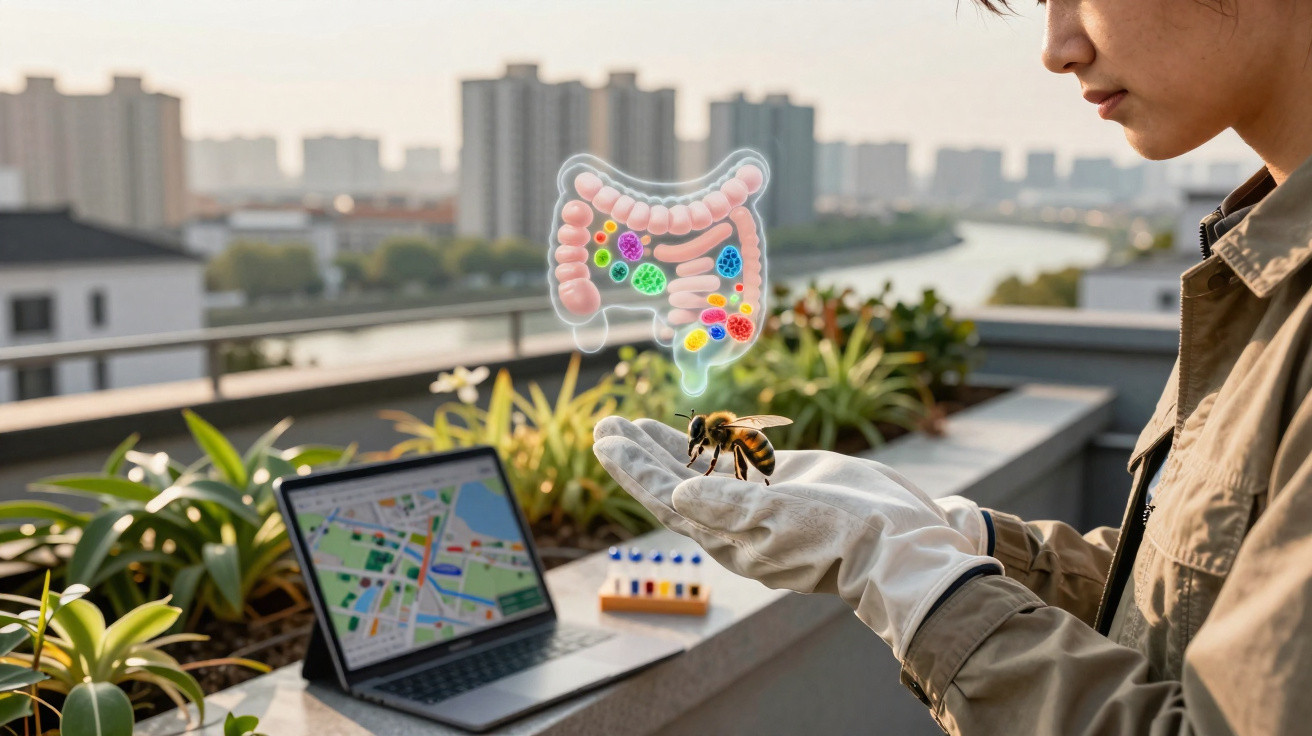
Across rooftops and balconies, on tatty roundabouts and in neatly kept parks, a discreet workforce of tiny auditors gets on with the job.
Every foraging trip and every mouthful of nectar leaves behind a trace too small to see. Inside a bee’s intestines, those traces accumulate into something resembling an unfiltered dossier on how a city actually manages its living spaces.
Bee intestines as an urban health report
Scientists in China have now translated that idea into measurable evidence. Researchers at Xi’an Jiaotong-Liverpool University examined the solitary mason bee Osmia excavata across ten urban farming locations in Suzhou, a rapidly expanding city far from being defined by pristine nature.
Rather than surveying flowers or testing pollution in the usual way, the team used metagenomic sequencing to catalogue everything present in the bees’ intestines. In a single gut sample, they analysed plant DNA, bacteria, viruses and even genes associated with antibiotic resistance.
The gut of a wild bee ends up working like a black box flight recorder for the urban environment that surrounds it.
The plant DNA told a blunt story. The bees’ diet was dominated by Brassica crops-cabbages and related vegetables-and by pollen from London plane trees (Platanus), a widely planted ornamental in many cities. That imbalance pointed to a reality urban planners do not often acknowledge: even in neighbourhoods that look green, flowers can be scarce.
The bees were not being fussy; they were making do. They fed on whatever was flowering near housing estates, roads and community gardens. From site to site, diets changed dramatically, reflecting local planting decisions more than any innate preference of the insects. This sort of make-do feeding is a sign of an urban landscape that appears leafy but fails to provide the diversity pollinators require.
What bee guts reveal about hidden microbial stress
The researchers went beyond the plants. The bees’ intestines were rich in bacteriophages-viruses that infect bacteria and can help keep microbial communities in equilibrium. Many of the phages detected had not been documented previously.
In the less pressured locations, these phages appeared to support a well-regulated microbiome. They helped prevent opportunistic bacteria from dominating and underpinned a stable, co-operative set of microbes that can digest pollen effectively.
In sites where urban pressures were stronger, that balance looked different. The researchers reported:
- Fewer bacteriophages that regulate microbial communities.
- More disturbance-tolerant, opportunistic bacteria.
- An increase in viruses associated with vertebrates, suggesting a heavier imprint from people and other animals.
When phage diversity drops and generalist microbes surge, the bee gut starts to mirror a stressed, overloaded city ecosystem.
The team’s case is that this microbial patterning can be a more sensitive indicator of environmental strain than traditional biodiversity surveys. Conventional counts tell you which plants, birds or insects are present; gut-based evidence hints at how well they are coping-what they are eating and how their bodies respond to pollution, landscaping and chemical exposure.
From bee bellies to better city planning
Because a single bee effectively visits dozens or even hundreds of flowers within a small radius, bees assemble a highly detailed picture of local urban ecology. Using those signals, the researchers proposed practical actions for city officials and gardeners.
| Bee gut signal | Likely urban cause | Suggested action |
|---|---|---|
| Monotonous plant DNA (Brassica, plane trees) | Ornamental monocultures, poor floral diversity | Mix native plants, edible crops and long-blooming species |
| Loss of regulating phages, rise of opportunists | Chemical stress, habitat fragmentation | Reduce pesticides, create continuous green corridors |
| More vertebrate-associated viruses, resistance genes | High human density, wastewater, pet presence | Improve sanitation, manage runoff, monitor microbial spillover |
One message was particularly clear: urban planting needs to be more than decorative. Blocks of identical trees and closely cut lawns may look impressive, but they contribute little to pollinators. A more resilient approach combines flowering shrubs, herbs, native wildflowers and productive crops, with bloom times staggered across the seasons.
Chemicals form the other major lever. Fungicides, insecticides and some herbicides can disturb beneficial gut microbes even when exposure remains below lethal thresholds. Once the microbiome is disrupted, bees extract nutrients less efficiently and become more susceptible to disease. Limiting particular compounds-or moving to targeted, low-impact treatments-can protect bee microbiomes while also benefiting human health.
When the “good” bacteria vanish
The study also highlighted another warning sign within the bees: a core microbiome led by Gammaproteobacteria, particularly bacteria from the genus Sodalis. These microbes help bees break down tough pollen walls, unlocking the proteins and fats needed for flight and reproduction.
At two of the ten sites, that core support appeared to fail. Sodalis almost vanished and was replaced by generalist bacteria such as Pseudomonas, which are often associated with disturbed or polluted conditions. The abrupt switch looked less like ordinary variation and more like a biological alert.
When specialist helpers vanish from the bee gut and generalists take control, something in the surrounding habitat has fundamentally changed.
The researchers linked the change to either poor floral diversity or chemical pressure. Bees in those areas still flew, foraged and returned with pollen, but internally their digestion likely became less efficient and their unseen buffer against ill health narrowed.
The team also detected 173 genes linked to antibiotic resistance across the gut samples. Overall levels were low, yet the pattern differed between neighbourhoods. That variation implies that bees, inadvertently, collect traces from hospitals, farms, homes and wastewater systems as they move around the city.
What this means for urban beekeeping and wild pollinators
The results pose practical questions for a fast-growing trend: beekeeping on roofs and in back gardens. Managed honey bee hives can overwhelm parks and community gardens when placed too near wild bee habitats. Greater density intensifies competition for a limited supply of flowers and increases the chance that pathogens spread between species.
The researchers advocate more deliberate zoning. Councils and gardeners could treat bees not as decorative mascots but as shared, vulnerable workers. Planners could:
- Set minimum distances between dense clusters of honey bee hives and important refuges for wild bees.
- Require pollinator-planting plans alongside approvals for new apiaries.
- Use gut monitoring as an early-warning system for emerging diseases in mixed bee populations.
Wild bees-such as the solitary species examined in Suzhou-often show the effects of habitat stress sooner than honey bees that are managed by people. Their gut microbiomes could act as early indicators of wider insect declines well before those shifts appear in public reporting.
How other cities could use bee-based monitoring
The approach trialled in China is straightforward to scale. By collecting wild bees-or, in some situations, taking non-lethal samples from managed bees-authorities could track environmental change across districts with near real-time resolution. Rather than relying solely on air-quality sensors mounted on lamp posts, councils could establish “bee observatories” supported by genetic laboratories.
Season-by-season gut profiling could show when a new pesticide begins to reshape microbial communities, or when a major development removes crucial floral corridors. That intelligence could then inform zoning rules, planting standards and even planning approvals.
Insurers and public health bodies may also take an interest. Gut data reflect not only flowers, but also dust, pollutants and microbial movement associated with wastewater and hospital outputs. If antibiotic resistance genes rise in bees, regulators may be prompted to reassess how medical and agricultural sectors manage their waste.
Beyond bees: a wider look at bioindicators
Bees are not the only possible biological sensors in urban environments. Birds, bats, urban foxes and even soil microbes can carry similarly hidden records within their bodies. Bees, however, offer clear advantages: they are common, relatively easy to sample, highly mobile at neighbourhood scale, and tightly tied to flowering plants.
For people keen to respond, pollinator-friendly gardening becomes more than a feel-good pastime. Diverse, pesticide-free planting helps stabilise bee microbiomes, which in turn keeps their “environmental reports” healthier. Community groups can connect bee-friendly corridors between balconies, school grounds and allotments, reducing the isolation that puts pressure on both insects and plants.
Researchers also see an educational opportunity. School projects can involve pupils in tracking bee health, linking what gets planted in a courtyard to measurable changes in local biodiversity. Making the connection between a packet of seeds and data from a nearby insect can introduce young people to ecology, microbiology and urban planning through something tangible.





Comments
No comments yet. Be the first to comment!
Leave a Comment