
A delivery lorry reverses in, the tail lift drops, and a small mountain of logs thunders onto the drive. The homeowner folds their arms, tries to look assured, and says, “That’ll easily get us through the winter.” The driver only smiles, says nothing, and pulls away. A few weeks later, the stack is already down by half - and it’s hardly even December.
The misconception refuses to die: that a “normal” 80 to 120 m² home only needs a few cubic metres of firewood. In practice it’s far less tidy - and far more costly - than most people want to admit. And the real jolt doesn’t arrive in a spreadsheet; it hits the day you can see the bottom row of logs.
Where the firewood myth begins to crack
Step into any DIY shop in October and you’ll hear the same chat in the firewood aisle. “We heat 100 square meters, three steres are enough.” People nod, share a knowing grin, and nobody runs the numbers. It’s comforting. It supports the pleasing notion that heating with wood is cheap, neat, almost magical.
But the truth sits in the smoke, not the stories. A draughty 90 m² house from the 1970s with poor insulation can chew through 10 to 15 m³ in a cold winter - sometimes more. Better-insulated homes do use less, but not nearly as dramatically as glossy brochures imply. That gap between the myth and a metre-high log stack is where irritation begins.
Consider a retired couple in an 85 m² stone house in central France. They booked 6 m³ in September. “We used 4 m³ last year,” they swore. By mid-January the woodshed was already hollow-sounding. Nights at –5 °C, doors that don’t seal properly, and a single-glazed hallway. Their stove was running from 7 a.m. to 11 p.m., almost without pause.
They rang their supplier in a panic. When the second lorry arrived, the driver knew the place straight away. “I deliver here twice every winter,” he said, almost gently. The couple had never really added it up. On paper, 80 m² seems modest. In reality - with drafts, high ceilings, and a kitchen door left open “just a bit” - the house behaves like a bottomless firebox.
The principle is harsh but straightforward: your stove doesn’t care about floor area; it cares about heat loss. Every crack, every thermal bridge, every cold wall has to be paid for in kilowatt-hours. A cubic metre of well-seasoned hardwood can provide roughly 1,500 to 2,000 kWh of usable heat in a good stove. In a poorly insulated 100 m² home, yearly demand often sits around 15,000 to 25,000 kWh.
Do the quick sums and you’re looking at about 8 to 12 m³ of wood - and sometimes more in tougher climates or exposed, windy locations. When someone insists they “get by with 4 m³”, they’re usually heating less than they think, relying on electric backups, or quietly topping up with pellets or gas. Very few households truly heat 80 to 120 m² solely with 3 or 4 m³ of wood at a comfortable 20 °C. The arithmetic simply won’t follow the fairy tale.
How to stop feeding the fire like there’s no tomorrow
The best “hack” for using less wood is painfully unglamorous: stop guessing and start measuring. Put an inexpensive thermometer in each main room and note the temperatures for one week. Record the wind, the outdoor temperature, and how many hours the stove is used. What felt like a vague sense of “we’re burning loads” becomes a clear pattern you can actually respond to.
Next, find where the heat disappears. Use the back of your hand around window frames. Notice how quickly rooms cool once the fire dies down. Foam tape on leaky doors and thick curtains can shift the whole equation. It’s not exciting - but it works.
On a behavioural level, the biggest enemy of your log pile is the “always-on” flame. Many people leave a tiny fire smouldering all day, producing very little warmth. The payoff is poor combustion, sooty glass, creosote in the flue, and a ridiculous number of logs sacrificed for a lukewarm outcome. Hot, short burns in a properly loaded firebox push more heat into the room and less up the chimney.
Let’s be honest: nobody keeps this up perfectly every day - a flawless refuelling timetable, temperature notes every hour, and millimetre-precise air settings. Still, switching from “two logs every hour” to “proper, hot burns twice in the evening” can cut a winter’s use by one or two cubic metres. It doesn’t sound dramatic. On the invoice, it is.
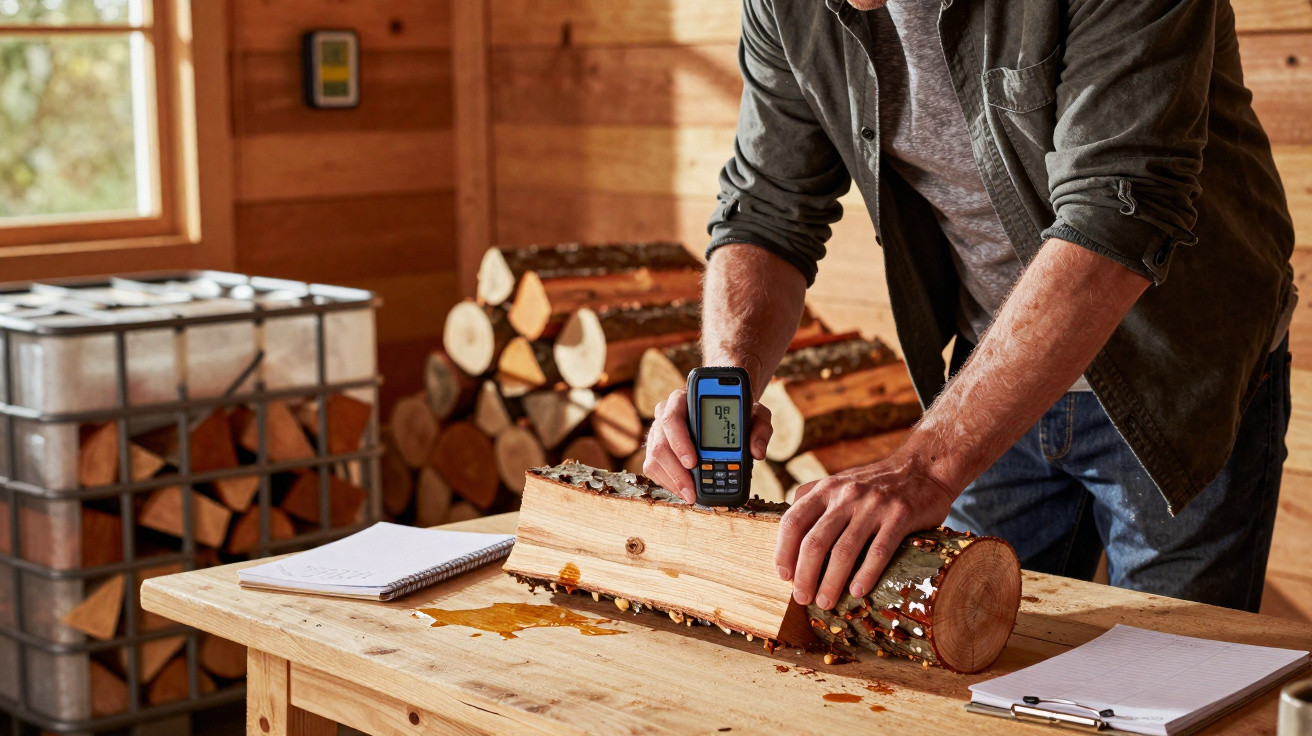
Then there’s the other major misconception: “dry” wood. Plenty of suppliers label logs as dry after 9 or 10 months. Your stove won’t agree. To properly season oak or beech, you’re typically looking at 18 to 24 months in a covered, ventilated spot. Above 20 % moisture content, a chunk of your fire’s energy is spent boiling water. You’re literally paying to evaporate moisture rather than warm your lounge.
A log at 30 % moisture can deliver up to a third less usable heat than one that’s properly dry. Across an entire winter, that loss is like giving away several cubic metres in invisible steam. A cheap moisture meter, a raised pallet, and a simple roof or tarp that leaves the sides open often save more money than yet another “high‑efficiency” stove add-on.
“The biggest shock for new wood‑burners isn’t the ash or the dust,” says Marc, a chimney sweep who has worked 25 winters in mountain towns. “It’s that they think 4 cubic meters is ‘a lot’ until January comes. Then they realize their house is a sieve and the stove is just trying to keep up.”
Under his bluntness is a quiet survival guide that experienced burners tend to follow without thinking. They base routines - and wood orders - on real numbers and worst-case winters, not wishful thinking. They know a single week of –10 °C can devour as much wood as the whole of March.
- Order at least one year ahead, so your wood has time to dry properly at home.
- Stack it off the ground on pallets, with airflow on every side, and a roof that doesn’t trap moisture.
- Keep a basic logbook: delivery date, species, volume, and how long it lasted. Your future self will be grateful.
Accepting the real numbers, changing the story
After your first “proper” winter heating with wood, the myths stop sparkling. You learn the sound of logs disappearing faster than your bank balance. You recognise the quiet worry when the stack drops in February and the forecast starts shouting “cold snap”. And you start talking about floor area differently.
Instead of “We heat 100 m² with 5 m³,” it becomes “Our 100 m² house, 70s build, semi‑detached, uses 8 to 10 m³ most winters.” That isn’t failure; it’s clarity. It also makes room for honest decisions: insulate the loft, replace windows in two rooms, or invest in a modern stove that suits the building’s needs rather than a catalogue photo.
On a calm evening, pay attention to the fire the way you’d watch a friend. How long does a full load of properly dry wood actually last at the comfort level you prefer? How does the house feel the next morning? At a human level, heating with wood isn’t just a numbers game - it’s a rhythm game: logs, timing, habits, and small repeated gestures, day after day.
At a wider level, it’s also about air quality and emissions. Smouldering fires and wet logs don’t merely wreck efficiency; they darken the air and add risk by coating your chimney. When we underestimate how much wood it truly takes to heat 80 to 120 m², we also underestimate the weight of those unseen clouds above towns and valleys.
Most of us know the moment: you point proudly at a neatly stacked pile and say, “This is winter sorted.” It’s a lovely idea. But the homes we actually live in - with their quirks, drafts, and half-finished insulation - tell a tougher story. The aim isn’t guilt. It’s facing the truth, then patiently, stubbornly bending it in your favour.
The next time a neighbour boasts about heating an entire house with three cubic metres, you might simply smile and ask a few questions. How many backup heaters? What temperatures? What are the walls like? Sometimes the bravado melts faster than snow on a south-facing roof. Sometimes they really have nailed a magic mix of insulation, stove, and habits. Either way, a conversation rooted in real numbers and lived experience is worth far more than another comforting firewood myth.
| Key point | Details | Why it matters to readers |
|---|---|---|
| Realistic wood use for 80–120 m² | In a typical older, semi‑insulated home, annual consumption often lands between 8 and 12 m³ of properly dry hardwood to keep 18–21 °C during a full winter. | Prevents under-ordering, last-minute panic deliveries, and helps you budget honestly instead of chasing unrealistic “3 m³ is enough” claims. |
| Impact of insulation level | A renovated, well-insulated 90 m² home may need barely half the wood of a similar uninsulated house, even with the same stove and climate. | Shows that every euro spent on insulation can save cubic metres of wood, transport, and the daily work of stacking and carrying logs. |
| Moisture content of logs | Wood above 20 % moisture can waste 20–30 % of its energy boiling off water; seasoning for 18–24 months on pallets, covered but ventilated, changes everything. | Explains why “cheap but green” wood ends up costing more, and why a small moisture meter is often the best heating investment you’ll make. |
FAQ
- How many cubic meters do I realistically need for 100 m²? For a fairly standard, older 100 m² house lived in year-round, many people end up between 7 and 12 m³ each winter, depending on climate, insulation, and preferred indoor temperature. “3 or 4 m³” claims usually conceal backup heaters, cooler rooms, or unusually mild winters.
- Why am I burning more wood than my neighbors with the same stove? The same stove placed in two very different houses will never consume the same. Drafts, ceiling height, ventilation habits, and how often internal doors are left open can easily double usage. Your firing technique and the quality of the logs also strongly influence how much heat actually stays indoors.
- Does upgrading to a modern stove really cut my wood use? Yes - particularly if your current appliance is old or is run constantly in “idle” mode. A correctly sized, modern clean-burn stove can often provide the same comfort with 20–40 % less wood, provided you use dry logs and burn in properly managed hot cycles.
- Is it worth buying wood two years in advance? For hardwoods such as oak, beech, or hornbeam, planning one to two winters ahead is a quiet game-changer. Combustion improves, rooms feel more comfortable, and chimneys stay cleaner - and you can order in the off-season, sometimes at better prices.
- How do I know if my house is making me waste wood? If rooms drop in temperature quickly once the fire goes out, if you can feel drafts near sockets or skirting boards, or if one side of the home always feels colder, your building envelope is leaking heat. A basic energy assessment - or even a simple smoke-pencil test around windows and doors - will show where your logs are “escaping”.




Comments
No comments yet. Be the first to comment!
Leave a Comment