
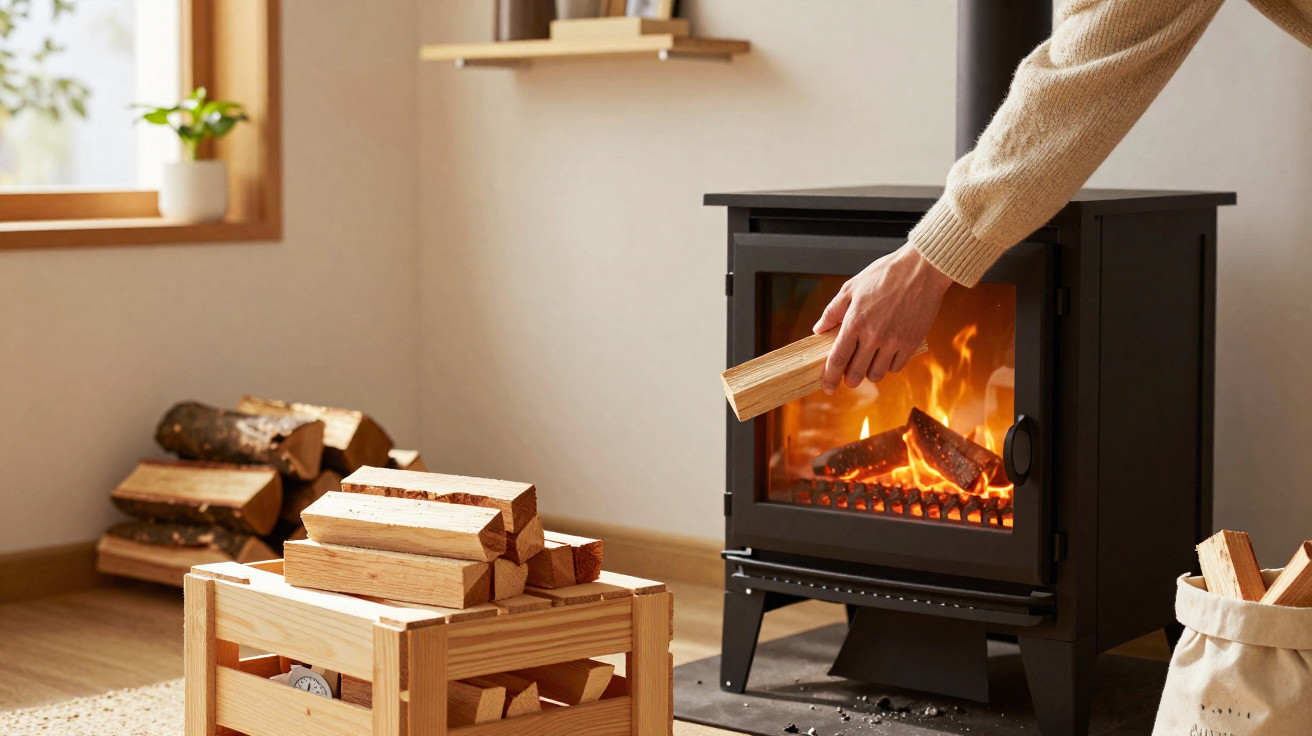
As winter draws closer, many stoves are being pushed to their limits - yet the living room can still feel only mildly warm.
Anyone who heats with a fireplace or wood-burning stove will recognise the situation: the wood pile disappears fast, costs creep up, and the warmth often spreads unevenly. A relatively new alternative is now getting plenty of attention: specialist wood briquettes made by compressing waste wood, designed to significantly increase the heat output from stoves and open fires.
What’s behind the new wood briquettes
These fuels - sold as wood briquettes or pressed wood - aren’t made from traditional split logs. Instead, they’re produced from sawdust and leftover wood offcuts, which are generated in huge quantities by sawmills, joinery workshops and the wider timber industry.
"Under extremely high pressure, dry wood residues are compressed into very dense, uniform briquettes - with no chemical additives at all."
Rather than looking like a conventional log, the finished fuel is closer to “wood in cube form”. That compact, consistent structure is exactly why more energy per unit volume is released during combustion. According to manufacturers, a single briquette can replace two to four standard logs - depending on the wood type and its condition.
Why the heat output is noticeably higher
The key advantage: very low residual moisture
Moisture content is often the decisive factor. Air-dried firewood typically sits at around 20–30% residual moisture, while poorly stored wood can quickly reach 40–50%. Wood briquettes, by contrast, are usually below 10%.
- Less water in the fuel means more energy ends up heating the room rather than disappearing up the chimney.
- The flame burns more cleanly, and the stove glass soots up more slowly.
- The appliance reaches operating temperature more quickly.
Because litres of water don’t need to be “boiled off” first, a much larger share of the energy stored in the wood becomes usable heat.
High density, long ember phase
Compression makes the material exceptionally dense. In practical terms:
| Fuel | Typical density | Effect in the stove |
|---|---|---|
| Air-dried split logs | approx. 400–600 kg/m³ | livelier flame, shorter ember phase |
| Wood briquettes | approx. 900–1,000 kg/m³ | calmer fire, longer burn time |
That higher density delivers:
- steadier heat over a longer period
- a significantly longer ember phase than many types of split logs
- less frequent refuelling - particularly useful in the evening or overnight
Practical, everyday benefits for households
Cleaner and easier to handle than split logs
Anyone who stacks, saws and splits several cubic metres of wood each year knows how much mess it creates. Wood briquettes are usually supplied cleanly wrapped - often in plastic film or cardboard - and they produce very little crumble.
"Less ash, less soot, less work - many users only need to empty the ash pan half as often."
As combustion is close to complete, fewer residues build up in the firebox and the flue. That reduces hassle and can also help keep chimney sweeping costs down, because the risk of excessive tar or soot deposits is lower.
Space-saving storage, no long drying period
This is especially relevant in towns, cities and terraced housing: you need far less space for a winter supply. In terms of calorific value, one cubic metre of wood briquettes provides roughly what would otherwise require several cubic metres of split logs.
On top of that, briquettes typically arrive from the manufacturer already dry and ready for the stove. No two- to three-year seasoning in a shed, and no arguments with the chimney sweep about wood that’s still too damp.
How to use the new briquettes properly
Step-by-step guide to lighting
The basic approach is similar to burning traditional logs. The following method has proven effective:
- Place two to three firelighters or eco fire-starters on the grate or in the firebox.
- Build over them with small pieces of kindling or half a briquette so the flame can catch.
- Light the starters and open the air supply wide at first so the stove heats up quickly.
- Once the fire is stable, add one to two whole briquettes - depending on stove size and the level of heat you want.
Important: wood briquettes expand slightly as they burn and then break apart. Avoid placing them too close to the glass, and don’t fill the firebox right up to the top.
Safety considerations and limits
Because the calorific value is so high, loading too much fuel at once also increases the risk of overheating. If you’re switching from standard logs, take it gradually and start with smaller quantities.
- Check the stove manual to see whether pressed wood is officially approved.
- Never load more than the manufacturer’s stated maximum wood quantity.
- Use a thermometer on the stove or flue pipe to keep an eye on temperatures.
If you’re unsure, a quick call to your chimney sweep or stove installer is worthwhile. Both will usually know the characteristics of common models very well.
Comparison with traditional firewood
Calorific value and burn characteristics
Good, dry hardwood such as beech or oak already performs respectably. Even so, high-quality wood briquettes often surpass it when it comes to usable energy per kilogram.
"A well-filled basket of pressed wood can produce the same heat effect as an entire car boot full of split logs - depending on the wood quality."
The flame typically appears a little calmer and more even. If you love the classic look and sound of crackling logs, you can also combine both fuels: split logs for appearance and ambience, briquettes for long-lasting, stable warmth.
Environmental impact and fine particulates
Because pressed wood is made from residues produced during timber processing, it’s considered particularly resource-efficient. No additional tree is felled purely for fuel; instead, material that would exist anyway is put to use.
The very dry, clean burn reduces emissions of fine particulates and unburnt gases. This matters especially in densely built-up areas, as more and more local authorities are monitoring air quality around wood-burning stoves.
What consumers should know before switching
What to look for when choosing
Not all wood briquettes are the same. The starting material, compression pressure and manufacturing quality can vary widely. Useful checks when buying include:
- CE marking or recognised test seals for solid fuels
- a stated moisture content (ideal: below 10%)
- a uniform, stable shape - briquettes shouldn’t already be crumbling inside the packaging
- a neutral smell, with no chemical note
Unpleasant surprises can occur if contaminants have been compressed into the product, such as painted timber or bonded board offcuts. Reputable manufacturers rule this out and clearly declare the raw material.
Costs, availability and sensible combinations
In price terms, wood briquettes are usually slightly more expensive than the cheapest split logs sourced locally, but often cheaper than premium, ready-to-burn branded firewood from specialist retailers. Once the higher heat output is factored in, the like-for-like comparison frequently works out cheaper.
Many users get the best results with a mix:
- briquettes as the “base supply” for the whole evening
- a few split logs for the classic fireplace feel
- occasional lighting with logs only when you want it warm quickly, but for a short time
In the shoulder seasons of spring and autumn, this makes it easy to fine-tune how much energy actually reaches the house - without constantly walking back and forth to the log pile.
Background: terms and real-world examples
Many retailers use labels such as “pressed wood”, “wood briquettes” or “densified fuel”. In practice, they mean broadly the same thing: tightly compressed, dry wood residues. Shapes range from cylinders with a hole through the middle to rectangular blocks. The hole improves airflow and helps deliver controlled, predictable burning.
In everyday use, plenty of households already rely on briquettes in different situations:
- as the main fuel in small wood-burning stoves in flats
- for long nights in a holiday cottage, when nobody wants to keep refuelling
- in older fireplaces where owners struggled with wood that was too damp
One benefit that’s easy to overlook: anyone who can’t carry heavy loads for health reasons may find the compact, neatly stackable packs much easier. They can be stored conveniently in a cellar, garage, or even in a corner of the hallway - as long as the space stays dry.
If you’re heading into the heating season and haven’t ordered fuel yet, starting with a trial pack can be a sensible approach. One or two sacks are usually enough to see how your stove responds, how the heat feels around the home, and whether consumption genuinely drops. That way, you can test the new option with minimal risk - and, in the best case, a handful of trial briquettes quickly becomes the new normal in the log basket.


Comments
No comments yet. Be the first to comment!
Leave a Comment