
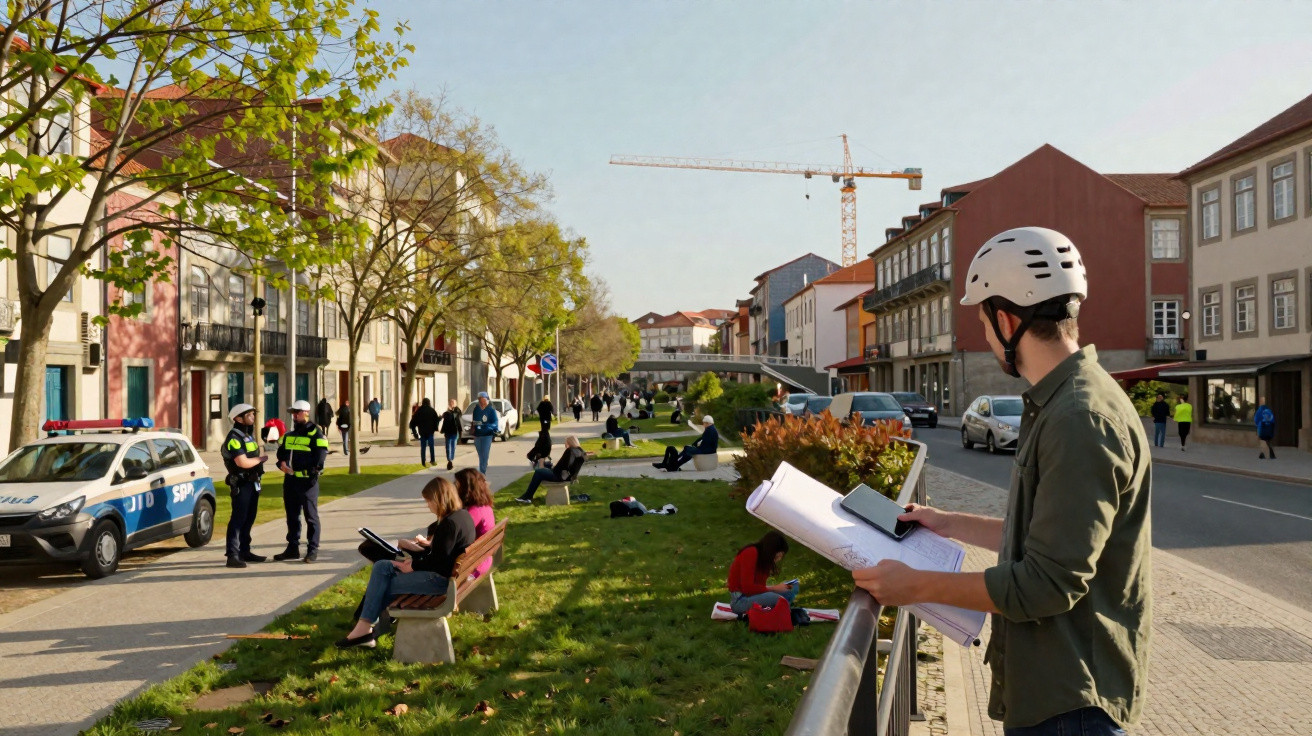
Porto City Council is moving ahead with plans for a new road to serve as an alternative to the VCI, alongside putting the Avenue of the Portuguese Business Association (AEP) underground to reconnect the two sides of the area it currently splits in Ramalde. The package also includes the creation of the Porto Economic and Business District and, on the policing front, an increase of 80 municipal police officers and 200 additional officers for the PSP metropolitan command by the end of the year.
The announcements followed a meeting between the Prime Minister, Luís Montenegro, and the Mayors of Porto and Lisbon, Pedro Duarte and Carlos Moedas, held at Rose Garden House in Porto. Described as “very productive”, the discussion lasted around two hours.
Via de Cintura Externa: an alternative route to the VCI
The new road-previously reported last month by JN-will be called the Via de Cintura Externa. Its purpose is to provide an intermediate connection between the VCI and the CREP (also known as the A41), enabling traffic to cross the city of Porto more effectively.
“If we look at this intervention in the light of resolving the Francos junction on the VCI, we may be looking at the biggest transformation in traffic, in the capacity to move flows across the metropolitan area and the city in particular,” Montenegro said.
Porto Economic and Business District in Ramalde
Alongside the new road, the Porto Economic and Business District will be established, which entails an urban reorganisation of the Ramalde Industrial Zone. According to the Prime Minister, this will help drive the area “towards a potential that brings together what already exists from an industrial point of view, from a services point of view, with new uses and new frameworks-particularly when it comes to technology companies.”
Pedro Duarte said the initiative is expected to support the creation of “up to 35 thousand new jobs” and “up to six thousand new homes for the middle class”.
“Our intention is to ‘bury’ the current AEP avenue to connect the two sides of that industrial area. And, in doing so, create a large housing park, business spaces, services and public space for communities to enjoy. For example, green areas, spaces for sport and the use of active travel,” the Mayor noted.
More police
Security was another topic on the agenda at the meeting between Luís Montenegro and the leaders of the Porto and Lisbon councils. The discussions brought positive news for Pedro Duarte, who received confirmation that an additional 80 municipal police officers and 200 more officers for the PSP metropolitan command will arrive by the end of the year.
“In line with the training processes currently under way-one finishing at the end of the first half of the year and the other at the end of the year-there will be that production of human resources so that we can continue this policy of treating security as fundamental to wellbeing, quality of life and also the attractiveness and effort of economic development in both territories,” Montenegro said. He added that there will also be a “reorganisation of services provided in police stations in Lisbon, Porto and Setúbal, with a view to freeing up a further 500 police officers for patrol duties”.
For the Prime Minister, strengthening patrol and policing activity-particularly in areas with higher levels of criminal incidence-will act as a “deterrent to crime”. There will also be scope for “deepening and developing technological solutions that can equip our officers with greater support”, so they can “be more efficient in their preventive and operational role”.
Pedro Duarte welcomed the decision, arguing that “the most effective measure is having more police on the street”. “This decision will have a very positive impact on the lives of people in Porto. We will see a very significant increase in police numbers on Porto’s streets and that, I have no doubt, will have a positive effect on peace of mind and security,” the Mayor of Porto concluded.




Comments
No comments yet. Be the first to comment!
Leave a Comment