
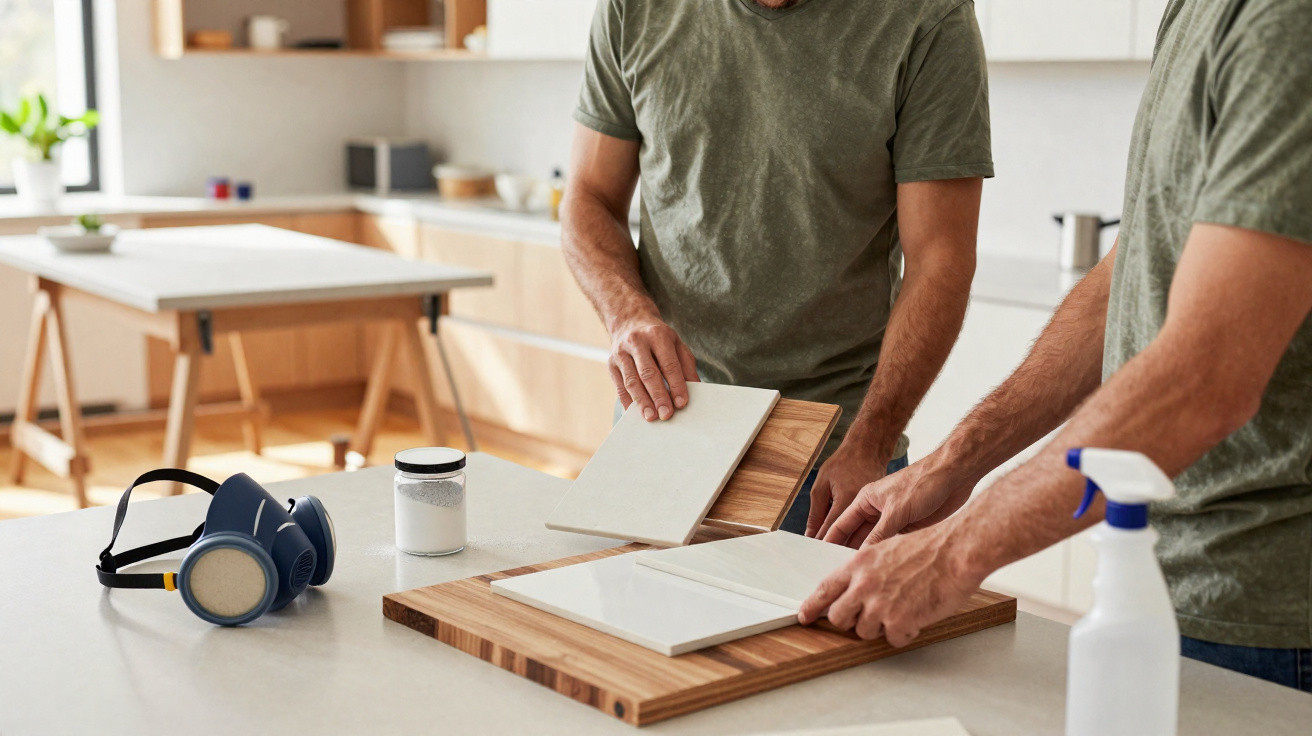
Quartz worktops continue to dominate kitchen showrooms, but a low-profile health controversy - and an abrupt ban in Australia - is changing the conversation.
Behind the polished photos of pale, veined counters and immaculate islands sits an uncomfortable question for engineered quartz: how can a surface that looks so refined involve such serious hazards for the people who cut and install it - and what should that mean for your next kitchen renovation?
What engineered quartz counters really are
Despite the name, most “quartz” countertops are not carved from a single block of stone. They are part of the engineered stone category, also sold as composite stone or reconstituted stone. In practice, manufacturers grind down natural quartz (and sometimes other rocks, including granite or marble), then blend the mineral powder with polymer resin and colour pigments.
That recipe produces a slab that feels comfortingly familiar: compact, consistent and sold in a wide range of colours, with finishes designed to resemble natural marble or granite. Because the resin locks the mineral grains together and effectively closes the surface, spills and splashes tend not to soak in - a key selling point in kitchens where sauces and brightly coloured drinks regularly hit the worktop.
The non‑porous finish also means it typically avoids the periodic sealing many natural stones require. And because it is made industrially, patterns can be tightly controlled: neat veining, dispersed glass fragments, metallic flecks, or very even shades that pair cleanly with contemporary cabinetry.
Engineered quartz behaves like a manufactured product, not like a block of rock cut from a quarry, even when the finish imitates marble to perfection.
That “halfway between plastic and stone” character sits behind both its popularity and its constraints: it offers precise, repeatable aesthetics, yet durability and behaviour vary according to each brand’s blend of quartz, resin and fillers.
Where the real danger lies: silica dust and silicosis
The concern is not about living with a quartz worktop day to day; it is about what happens when it is shaped. Quartz-heavy engineered stone can contain extremely high proportions of crystalline silica - sometimes above 90%. Silica is common in nature (from sand to granite), but the hazard appears when power tools cut, drill, grind or polish the slab and generate fine airborne dust.
When inhaled, these tiny particles can reach deep into the lungs. Over repeated exposure across months or years, they can cause silicosis: a severe, irreversible lung disease that scars tissue and reduces the ability to breathe. It can show up in comparatively young workers after several years spent cutting, polishing or drilling engineered stone where dust controls are inadequate.
Public health researchers now treat engineered stone work as a high-risk activity, closer to asbestos removal than to traditional stonemasonry.
Over recent years, clinicians in multiple countries have documented clusters of rapidly progressive silicosis among kitchen worktop fabricators. Some people have presented with advanced disease before the age of 40. In the UK, press coverage has pointed to rising case numbers in stone workshops and has prompted scrutiny of whether existing workplace exposure limits for silica dust are sufficiently protective for this particular material.
Why Australia moved to ban high-silica engineered stone
Australia has taken one of the toughest positions so far. Following investigations and growing clinical evidence, Australian authorities opted to ban certain engineered stone products from 2024. The focus is on engineered materials with high crystalline silica content, as these present the greatest risk during cutting and polishing.
Australian health specialists argued that, even where rules exist, many smaller workshops found it difficult to keep dust consistently under control. Wet-cutting equipment, on-tool extraction and properly fitted respirators all require investment and training. Inspectors also reported cases where fabricators worked indoors using dry cutting methods, leaving visible dust clouds around staff.
That policy decision rippled through the global kitchen market. Engineered quartz had become positioned as a mid‑ to high‑end surface: hard-wearing, hygienic and visually versatile. Then, abruptly, one of the largest markets chose to step back from much of the category.
Across Europe, medical bodies in the Netherlands and the UK have already pressed for stronger controls, and some have called for an EU-wide ban on high-silica composites. France’s health agency highlighted concerns as far back as 2016. Regulators are now weighing a difficult trade-off: protecting workers while trying to avoid severe disruption for manufacturers and households in the middle of renovation plans.
Should homeowners worry about existing quartz countertops?
If you already have engineered quartz installed, everyday use is not comparable to fabrication work. Once in place, the slab does not normally shed dust. Routine cooking, cleaning and wiping do not generate airborne crystalline silica.
The risk reappears if the worktop is later cut, drilled or ground. That situation can arise when installing a new hob, swapping a sink, altering plumbing, or trimming back a counter run. A DIY approach using a dry angle grinder and no respiratory protection can unknowingly reproduce the most hazardous workshop conditions inside the home.
The key risk for households lies not in the surface itself, but in any unprotected cutting, sanding or drilling that damages it.
If an existing quartz worktop needs alterations, it is safer to use a professional who employs wet-cutting techniques, strong extraction and suitable respiratory protection. Even a job that seems minor - such as adding a tap hole - can create a substantial burst of dangerous dust if done carelessly.
Heat, cost and day-to-day quirks of engineered quartz
Health concerns are not the only reason to think carefully before accepting a quartz worktop quote. Several practical limitations are often downplayed in marketing.
How quartz reacts to heat
Some natural stones (and concrete) can cope with fairly high temperatures. Engineered quartz behaves differently because it contains resin. Many manufacturers state temperature tolerance up to about 150°C (roughly 300°F). Hot bakeware or cast-iron cookware can exceed that, particularly straight from a very hot oven.
If the heat goes beyond what the resin can withstand, the surface may discolour, crack or lose its glossy finish. One lapse - for example, placing a roasting tray directly onto the worktop - can leave a lasting blemish. In homes that cook often with heavy, high-heat cookware, this can become an everyday practical constraint.
- Always put trivets or heat mats under hot pans and baking trays.
- Do not sit air fryers, slow cookers or coffee machines that vent heat directly onto the surface unless they are on a suitable stand.
- Leave a small gap between toasters (and similar appliances) and the splashback to avoid concentrating heat.
Financial reality: more than just the slab price
Engineered quartz worktops are commonly priced alongside many natural stones. By region, thickness and brand, installed costs are often quoted at around 75 to 200 US dollars per square foot (roughly $800–$2,150 per m²). Designs that convincingly imitate high-end marble usually sit toward the top of that range, and labour-intensive details - such as elaborate edges or “waterfall” panels - add further cost.
Openings and shaping for under-mounted sinks, integral drainers, sockets and taps all increase labour time and the chance of breakage, which is reflected in the final bill. More familiar options such as solid wood or laminate can be significantly cheaper, and in some markets certain porcelain choices can also be cost-competitive once widely available.
DIY fitting is rarely appropriate for engineered quartz. The slabs are heavy yet can be brittle, making handling risky for both the material and the installer. Dust is also a central issue: on-site trimming without wet tools and extraction can expose anyone nearby to silica.
Alternatives gaining ground: from porcelain to recycled wood
As awareness of silicosis grows, suppliers are shifting their offers. Some promote “low-silica” engineered options that cut the quartz content and change the mineral blend. Others encourage customers to choose different surfaces that avoid the problem at source.
Porcelain slabs and sintered materials
Over the past decade, large-format porcelain worktops have moved from glossy design features into mainstream brochures. These are produced from mineral powders fired at extremely high temperatures, creating a dense, non‑porous slab with comparatively lower crystalline silica content than many traditional engineered quartz mixes.
They generally cope well with high heat, resist UV exposure, and can be stain-resistant when correctly sealed. Fabrication still demands specialist skill and the right saws, but the silicosis risk picture is different because the composition - and therefore dust behaviour - is not the same as high-quartz composites.
Hybrid materials such as Dekton
Surfaces such as Dekton combine glass, porcelain and a proportion of quartz, processed under very high heat and pressure. They are commonly marketed as “sintered stone”. Brand messaging often centres on resistance to scratching, thermal shock and sunlight, which appeals for outdoor kitchens and bright, south-facing rooms.
These slabs are extremely dense and can be difficult to cut. Fabricators typically need specific training and dedicated blades, but the reduced share of quartz can lower the amount of pure crystalline silica available to become airborne dust.
Wood and recycled options
Wood worktops have long been criticised for staining and knife marks. However, improved finishes - and a more accepting attitude to patina in “lived‑in” kitchens - have renewed interest. Some manufacturers now use timber from offcuts or reclaimed sources, helping to reduce environmental impact.
Woodworking still creates dust when timber is cut or sanded, and that carries its own health considerations, but it does not involve the same silicosis mechanism. Extraction and masks remain important in joinery, yet the long-term lung scarring pattern is different.
| Material | Main benefits | Main drawbacks |
|---|---|---|
| Engineered quartz | Uniform look, non‑porous, wide colour range | Silica dust risk during cutting, heat limits, cost |
| Porcelain / sintered stone | High heat resistance, UV stable, low porosity | Challenging to fabricate, can chip on edges, price |
| Natural granite | Robust, handles heat better, unique patterns | Needs sealing, pattern less predictable |
| Wood / butcher block | Warm look, repairable surface, can use recycled timber | Needs regular care, sensitive to water and heat |
How to approach a remodel in the post-quartz debate era
If you are planning a new kitchen, choosing quartz now involves extra due diligence. Asking what percentage of crystalline silica is in the proposed product is no longer an obscure technicality. A responsible retailer should be able to say whether they are supplying high-silica engineered stone or a lower-silica alternative - and what protective measures the fabricators use.
You can also ask for all cutting and polishing to be completed in a controlled workshop rather than in your home, limiting on-site adjustments to the bare minimum. That approach reduces the chance of airborne dust indoors, even when tradespeople follow best practice in the factory.
Some homeowners are also redirecting part of the money they would have spent on premium quartz patterns into improved ventilation or a more ergonomic layout. That swap can deliver more everyday comfort than any single surface finish. Often, a simpler worktop paired with thoughtful lighting and storage planning changes how the kitchen feels more than a fashionable marble look-alike.
Beyond quartz: other renovation risks worth weighing
The engineered stone discussion also highlights how easily health risks in home improvement get overlooked. Plenty of popular materials raise questions that rarely appear in aspirational mood boards. Vinyl flooring can release volatile organic compounds. Spray foams and some insulation products can irritate airways while being applied. Older homes may still conceal lead paint or asbestos in walls and ceilings.
Viewing renovation as a chain of potential exposures - rather than purely a list of purchases - changes the priorities. It also makes dust control, ventilation and protective equipment part of the same discussion, whether a contractor is drilling engineered stone, sanding paint or cutting tiles.
Quartz worktops now sit where design, health and regulation meet. The Australian ban has simply made that crossroads harder to ignore, pushing homeowners, designers and policymakers to decide what level of risk is acceptable for a surface that, until recently, was seen as the easy, modern default.


Comments
No comments yet. Be the first to comment!
Leave a Comment