
The homeowner paused in the centre of her kitchen, thumb flicking through her phone as a before-and-after reel played on repeat. In the “after”, the cupboards hadn’t been ripped out at all - they’d simply vanished behind shiny panels that looked like stone… but weren’t. It was a thin layer of plastic, clipped on like Lego.
“it cost less than a weekend away,” she said, a touch pleased and a touch on guard. When her friends arrived, they ran their hands over the new surfaces and said wow, this looks expensive. No one asked what it was actually made from. No one particularly wanted the answer.
That’s the low-key sleight of hand happening in kitchens right now.
Goodbye cabinets, hello plastic ‘luxury’ skins
Scroll through Instagram, TikTok or a local Facebook group and you’ll see the same makeover again and again: tired wood or melamine units concealed by plastic panels printed to resemble oak, marble or concrete. The carcasses stay put. Often the doors stay put. Yet the whole kitchen appears to change overnight.
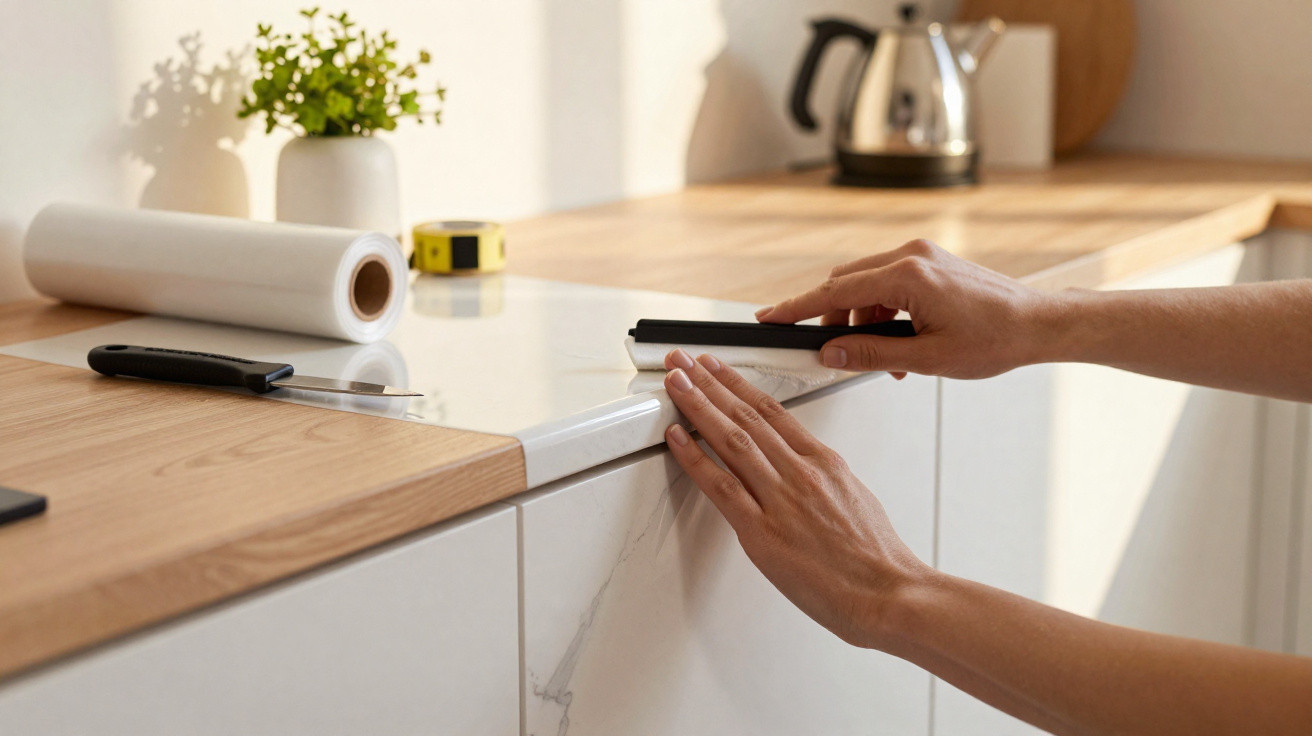
Most of these “new” fronts are vinyl wraps, PVC panels or laminate fronts ordered online, cut to size, then applied with adhesive strips and a heat gun. In a photo, they read as “custom kitchen”. Up close, they can feel light and faintly hollow. Even so, plenty of people describe it as an upgrade.
There’s an odd satisfaction in spending less on something that looks like more. We’ve drifted into a moment where “looking renovated” can trump “being renovated”.
A London-based installer told me that in 2020, plastic wrap jobs were maybe 10% of what he did. Now, he says, they’re close to 60%. And it isn’t only renters stretching a budget. Some customers arrive in electric SUVs asking for “the expensive marble look, but the peel-and-stick version”.
On TikTok, videos tagged #kitchenwrap have collected hundreds of millions of views. In a 30-second time-lapse, a worn oak kitchen becomes a bright “Scandi” white box: no sanding dust, no plumber, no disruption. The comments don’t ask about longevity - they ask for links.
One couple in Ohio covered every visible surface in faux-walnut film over a single long weekend. They shared their costs: under $500 for what would have been tens of thousands with proper carpentry. Their landlord’s response was a text: “Looks nice. Don’t damage the walls.” That was the only quality check.
Part of this plastic surge is simple maths. Bespoke cabinets can swallow half of a renovation budget. Plastic lookalikes offer a loophole: you get the visual payoff with far less structural commitment. No demolition, no skips, no three-week wait for a fitter.
It’s also fuelled by the speed of taste. A kitchen that was “in” five years ago can look tired against today’s feeds. Fast fashion has quietly seeped into interiors. If a style might feel dated in three years, it’s easy to think: why pay for real oak? Why not buy the illusion and swap it out when you’re bored?
And people almost never announce, “I bought plastic.” They’ll say “we modernised the kitchen”, “we went for a clean slab look” or “we redid the fronts”. Mood boards and hashtags blur the material truth.
How kitchen wrap and cabinet wrap projects are actually done (and what goes wrong)
The method is almost suspiciously straightforward. You measure your existing doors and drawer fronts, order pre-cut PVC or vinyl panels online, and spend a day or two covering every flat surface. A hairdryer or heat gun helps the film mould around corners. A plastic squeegee pushes out trapped air.
Many people don’t replace doors at all - they simply wrap what’s visible: the fronts, side panels and, if they’re being thorough, the kickboards. The frames, hinges and usually the interiors stay exactly as they were, sometimes decades old. On camera, though, it can pass as “new build”.
Some take it further, adding push-to-open mechanisms or minimalist handles to sell the impression of a premium installation. The result is a kind of costume: old bones dressed up in a glossy outfit, ready for a social media close-up.
When it fails, it often fails where kitchens are harshest: corners and the area around the sink. Moisture and heat are the natural enemies here. Peel-and-stick panels can begin to lift at the edges if the prep work wasn’t spot-on. Grease from a nearby hob can stain or gradually soften certain films.
A renter in Paris wrapped her laminate worktop with faux-marble vinyl. For three months it looked flawless. Then a hot pan left a pale ring that never went away. She posted an “after-after” image: the same pretty film, but now with sections where the plastic had shrunk back from the sink cut-out.
Another common disappointment is touch. Your eyes buy the veined “stone”. Your hand meets warm plastic. On a screen, that mismatch barely registers. Standing barefoot in your own kitchen at midnight, it can.
Financially, the appeal is obvious. In the UK, professionally fitted cabinet wraps might cost between £800 and £2,500 for a medium-sized kitchen. Replacing cabinets outright in a comparable style can easily reach £8,000–£20,000 before appliances.
For many households, the internal question quietly becomes less “Is this top quality?” and more “Is this good enough to enjoy living with?” Often the answer is yes - at least for the next five years. Real kitchens aren’t showrooms: kids slam doors, guests spill red wine, pets chew corners. In that reality, a sacrificial plastic surface can feel less nerve-racking than pristine timber.
There’s also a psychological layer. A kitchen upgrade has long been shorthand for “we’ve made it”. Plastic lookalikes let more people take part in that story, even if the backstage is different. The emotional upgrade is real; the cabinets simply play their part.
How to “fake” an upgrade without faking yourself out
If you’re drawn to the plastic option, start with the dullest step: inspect your kitchen in unforgiving daylight and physically handle everything. A sagging door, a wobbly hinge or swollen chipboard around the sink won’t suddenly behave better once it’s wrapped.
Begin by tightening hinges, securing loose screws and replacing any doors that are already warped. Then choose a “test zone” - one wall unit, for instance - and wrap only that. Keep it for a week. Cook as usual. Splash water. Clean it the way you normally would.
Pay attention to how it feels when you’re half-awake making coffee. If you catch yourself tiptoeing around it, that’s information. An upgrade should fit your habits, not require you to reinvent yourself.
Most disappointment comes from treating plastic fronts as bombproof. They aren’t. Use a knife directly on a vinyl-wrapped surface and you’ll score it. Slide heavy pans across a PVC panel and it will scratch. Boil pasta constantly beneath a wrapped wall cabinet and, in that exact area, the adhesive can start to soften.
A small, practical trick: leave a realistic-looking sample near your hob for a week before committing. Let it collect splatters. Wash it with whatever you genuinely use, not the “recommended” gentle cleaners. Let’s be honest: nobody keeps that up every day with a perfect microfibre cloth.
If you rent, photograph everything before and after. Some landlords are thrilled by anything that looks newer. Others get nervous the moment they hear “adhesive”. A clear record helps if you ever need to peel it back or negotiate over your deposit.
“People aren’t really buying plastic,” says one interior designer who quietly specifies high‑grade laminates for budget projects. “They’re buying time. Time before the next move, the next trend, the next real renovation. The material is just the costume for that in‑between stage.”
There’s a line between a smart shortcut and pure theatre. Wrapping an ugly but structurally sound cabinet can be a genuinely sensible hack. Covering up crumbling chipboard or damp damage isn’t. That’s where the “fake” upgrade starts feeling like you’re lying to yourself, not just to Instagram.
- Use heat sparingly on edges so you don’t stretch the film or distort the pattern.
- Choose mid-sheen finishes; ultra-gloss films highlight every fingerprint and bubble.
- Keep offcuts in a drawer so you can patch inevitable nicks and chips quickly.
| Key point | Details | Why it matters to readers |
|---|---|---|
| Realistic costs vs full replacement | Wrapping a standard 10–12 unit kitchen in vinyl or PVC panels often runs between £800 and £2,500, including materials and basic labour; new mid‑range cabinets with fitting typically start around £8,000–£15,000. | Helps you see whether a plastic “upgrade” is a smart bridge solution or whether saving longer for a full refit better suits your budget and long‑term plans. |
| Lifespan and wear patterns | Quality wraps last roughly 3–7 years in a busy family kitchen, with early wear normally appearing on drawer fronts, sink edges and near the hob where heat and moisture are constant. | Gives a realistic timeline so you’re not shocked when the first edges lift, and you can decide if re-wrapping every few years feels acceptable or exhausting. |
| Best surfaces to wrap (and avoid) | Flat, smooth cabinet fronts and side panels tend to wrap well; swollen chipboard, heavily profiled doors and damaged worktops are far more prone to bubbling, peeling and visible seams. | Helps you choose where plastic can be a clever fix and where you’re better off repairing or replacing rather than hiding problems under a thin decorative layer. |
A quiet shift in what “upgraded” really means
A subtle change in status is playing out in kitchens. For years, solid wood and weighty stone were the quiet code for “we’re doing well”. Increasingly, people are comfortable with a different message: “we made it look good enough to enjoy, for now”.
A roll of vinyl doesn’t come with a moral judgement attached. It’s simply a tool. For some, it’s a genuinely life-improving way to brighten up a depressing 1990s rental and feel better making breakfast. For others, it becomes a way of delaying bigger decisions about how they want to live - and where.
On a grim Tuesday night, if you’re standing in a kitchen that finally feels like yours, it may not matter in the slightest that the “stone” is plastic. On a quiet Sunday, you might find yourself tracing a lifting edge and imagining what it would feel like to commit to something permanent. A social feed built for speed never shows that part.
Most of us know the feeling of a quick fix that leaves you oddly proud and slightly uneasy. Kitchen wraps and plastic fronts sit right inside that emotional gap. They offer instant transformation, and they usually deliver it. The lingering question is simple and a bit uncomfortable: how much illusion are you personally happy to live with, day after day, behind closed doors?
FAQ
- Are plastic-wrapped cabinets safe near heat and steam? Most branded wraps are rated for typical kitchen temperatures, but they don’t love constant steam or direct heat. Keep them a sensible distance from gas burners, use an extractor fan, and expect the area above the hob and around the kettle to show wear first.
- Will wrapping my cabinets damage the surface underneath? On smooth melamine or painted MDF, quality films usually peel off with only minor adhesive residue, especially within a few years. On fragile or already flaking chipboard, removal can take some of the surface with it, so test a small hidden spot before committing.
- Can I wrap a tired laminate worktop and actually cook on it? You can, but with limits: no hot pans directly on the surface, use chopping boards religiously, and expect a shorter lifespan than a solid laminate or stone top. It works best as a cosmetic refresh in light‑use kitchens rather than for daily heavy cooking.
- How do I choose a finish that won’t look cheap in real life? Matte or soft‑sheen textures generally look more convincing than ultra‑gloss, and subtle patterns beat hyper‑realistic “3D” marble veins. Order physical samples, tape them to a cabinet and look at them in morning, midday and evening light before deciding.
- Is it worth paying a pro, or should I DIY the wrap? If your kitchen has lots of fiddly profiles, tight corners and integrated appliances, a professional fitter can save you a lot of swearing and wasted material. Straight, flat fronts in a small space are realistic for a patient DIYer who’s comfortable measuring carefully and working slowly.




Comments
No comments yet. Be the first to comment!
Leave a Comment