
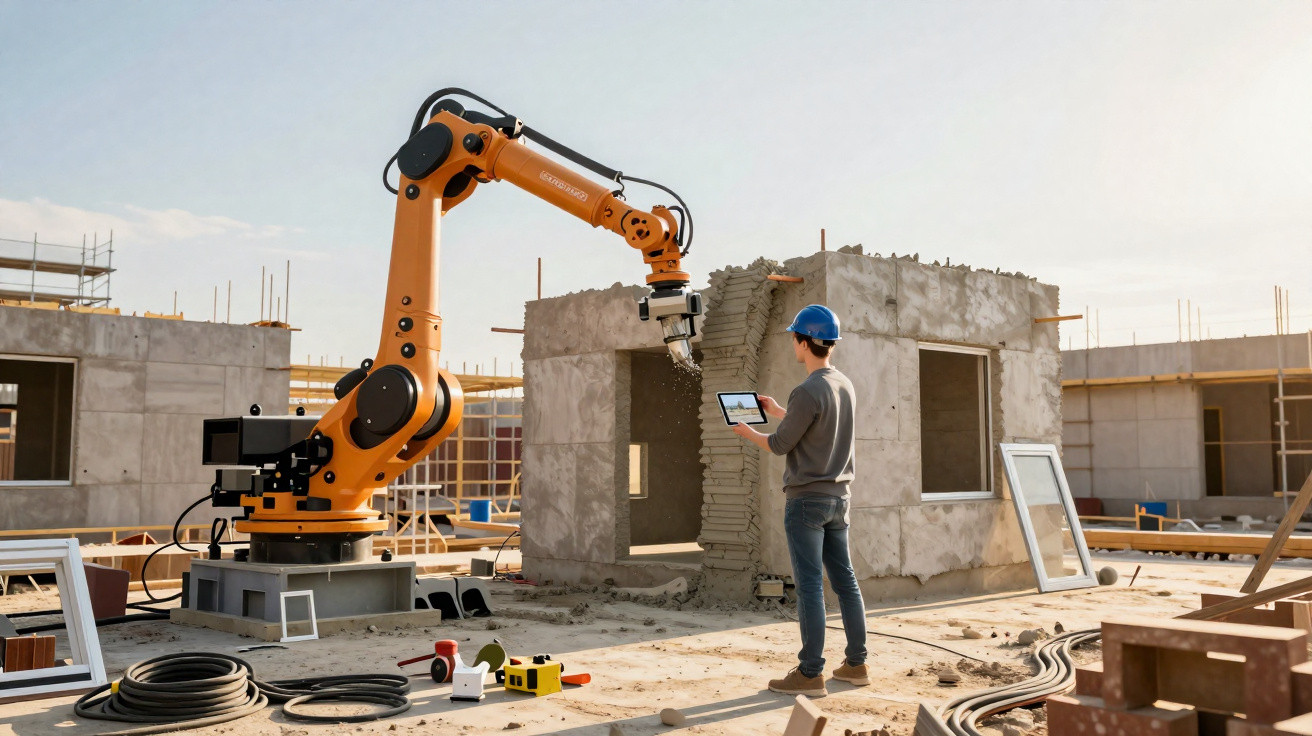
Walls appear in minutes. The roof follows. Finished. At least, that’s the impression the sped-up clip is designed to leave you with.
On a phone screen, a house seems to pop into being between two notifications and a quick doomscroll. It looks like a future without muddy boots, endless slippage, or neighbours muttering about noise at 6am. Technology meets shelter. Sorted, right?
Then you speak to anyone who’s actually tried to build a home-robots or no robots-and the timeline looks very different. Forms, permissions, utilities, inspections. The bit that feels instantaneous is just one scene in a much longer process.
The speed is genuine. The shortcut isn’t.
Why robot-built homes look instant – and why your keys still arrive late
Open any feed and you’ve likely seen it: a robotic arm on a bright plot, extruding neat bands of concrete while a caption boasts “House printed in 48 hours”. The edit jumps from an empty slab to a standing shell quicker than reheating leftovers. Your mind fills in the missing steps: job done.
The trick is how normal those leaps feel now. The internet speaks in time-lapses-clouds sprint, plants unfurl, buildings climb. We’re trained to expect the satisfying reveal. So when a robot appears to “print” a house, we anticipate the same friction-free payoff. The waiting, the snags, the real-world drag? Quietly cut.
From Austin to southern England to open plots outside Nairobi, the same pattern plays out. A 3D-printing rig turns up on site, curious neighbours filming from the boundary. Over a couple of days, skeletal walls rise layer by layer-like a giant pottery coil, threaded with rebar. Someone records the final sweep of the nozzle, adds upbeat music, posts to Instagram, and the views climb into the millions.
But if you look carefully, the absences are loud. There’s no clip of the half-year grind to get planning permission. No audio of an architect debating fire regulations. No footage of a plumber working out how to route pipes through a form the local inspector has never encountered. That “silent” time is spent in emails, calls, redraws, and back-and-forth.
Robots are brilliant at what you can see: repetitive, accurate, physical work. Wall-building is exactly that. Concrete goes where the machine directs it, without tea breaks or sudden weather delays. The catch is that a home isn’t just walls. It’s certificates, connections, safety checks, arguments over light fittings, and a grid never designed for anything to happen instantly.
So when a company says, “We can print a house in two days”, that can be perfectly true about the mechanical act. The illusion is treating those two days as the entire journey from empty plot to move-in selfie. Plenty of the project time hasn’t been removed-it’s been displaced into places the camera rarely visits: design, logistics, approvals, supply chains, and bureaucracy that runs at human speed, not robot speed.
Where the “hidden” construction time actually lives
A useful way to watch robot-built home videos is to split them into two halves: what the camera shows, and what never enters the frame. Then ask, almost automatically: “What happened before the first second of this clip-and what happens after the last second?” That one habit changes how you hear promises of instant housing.
Long before a robot touches concrete, someone selects the site, purchases the land, commissions surveys, and deals with whatever the ground report reveals. In many places, planning alone can take a year. It isn’t TikTok-friendly. Nobody wants to watch a time-lapse of a solicitor refreshing their inbox or an engineer revising drawings.
Once the time-lapse ends, another category of delay begins. After the walls are printed, traditional trades still need to turn up: electricians, plumbers, window fitters, roofers. Some may be on their first robot-printed job and will have to improvise solutions that no handbook covers.
In other words, a very human supply chain is trying to connect into a machine-speed shell. If one item slips-a made-to-measure window, a particular insulation type, a connector specified by the printer supplier-the entire site can go quiet. The robot has finished. Everything else has to catch up, sometimes at a painfully slow pace.
Regulation also needs time to catch up. Building rules were written with bricks, timber and steel frames in mind. Inspectors know where to tap, what to measure, and which warning signs to take seriously. With robot-printed concrete, they’re often learning as they go. That uncertainty can trigger extra testing, more paperwork, and additional meetings-hidden days and invisible weeks.
None of this is a claim that the technology is pure hype. It’s that the timeline gets distorted. The robot compresses a narrow slice of the overall process, and the steps around it stretch to absorb the change. So the wait for a liveable, lawful, insurable home shrinks far less dramatically than the viral videos suggest. Time hasn’t disappeared-it’s simply taken on a different shape.
How to read the hype – and what to watch for next
A simple way to stay realistic: whenever you see “House printed in X hours”, add three questions in your head. Who dealt with the paperwork? How long did utilities and inspections take? And when did someone actually sleep in the building for the first time? That short checklist breaks the spell of the edit.
If a company is serious, it will discuss end-to-end timelines rather than print time alone. Look for wording such as “permit-to-keys” or “foundation to occupancy”. When those figures appear, set them against standard builds in the same area. Sometimes the gain is huge. Sometimes it’s modest-and the glossy robot footage is doing most of the persuading.
The common trap is comparison. You watch a robot raise walls over a weekend and your own renovation instantly feels prehistoric. Your contractor’s late, the kitchen is chaos, and you start wondering why you’re not already living in a 3D-printed pod.
There’s also a deeper anxiety: will “traditional” builders be pushed out? Will housing become yet another domain controlled by big tech? On the wrong day, the promise of instant homes can sound less like progress and more like a threat-if a machine can build a house in 48 hours, what does that imply about the value of everyone currently on site, boots in the mud?
Let’s be honest: hardly anyone is doing this as an everyday routine. Nobody is casually 3D-printing a new house every weekend the way you might batch-cook soup. Most real projects are pilots, prototypes, or tightly managed developments backed by venture capital, NGOs, or governments trialling something new.
As the technology develops, the quieter skills become more important: planners who understand both robots and regulation, councils willing to modernise codes, small builders who can bring machines into their workflow without losing who they are. The future of housing isn’t robots replacing people-it’s how effectively people reorganise around robots.
“The robot is the easy part. Reinventing everything around it – from the contract to the last inspection – that’s where the real work hides,” a London-based structural engineer told me off the record.
- Look beyond the clip: Ask what happened before and after the filmed build.
- Follow complete projects, not one-off demos, to see where time really goes.
- Pay attention to the boring bits: Permits, inspections, and utilities still dictate the schedule.
- Treat speed as one metric, not the only measure of progress.
- Talk to locals: The same robot produces very different outcomes under different rules.
What instant houses really tell us about time, tech and homes
Watching a robot trace a house into existence hits a deep nerve. Housing feels broken in many cities: prices spiralling, timelines slipping, waiting lists fading into the distance. It’s natural to want a machine that can slice through the mess-a clean, precise arm clearing up what humans have made complicated.
The uncomfortable truth is that the worst delays in housing aren’t technical. They’re political, financial and cultural. A printer can lay concrete quickly, but it can’t release more land, repair rental law, or negotiate with a neighbour who hates change. The hidden time in building lives in those arguments, those meetings, those decisions.
Robot-built homes reveal something odd about how we relate to time. We fixate on the part that accelerates, and barely notice the parts that don’t. The danger is mistaking polished footage for a solved problem-then feeling cheated when reality arrives with its usual stack of forms and muddy boots.
That’s not a reason to dismiss the idea. It’s a reason to ask sharper questions. Who wins when houses go up faster? Who loses if building becomes a software-led process? Why do some communities welcome robot-built developments while others block them at the planning stage?
Between the viral clip and the moment the key turns in the front door, a new approach to building is quietly forming. Not instantaneous. Not magical. Just a slow negotiation between code, concrete, and the very human need for a place that feels like home. That’s the part you rarely see on video-and the part worth discussing.
| Key point | Detail | Why it matters to you |
|---|---|---|
| Robot speed is real but narrow | Machines dramatically reduce wall-building time, not full project timelines | Helps you judge hype versus reality in viral “instant house” videos |
| Hidden time shifts elsewhere | Permits, inspections, trades and supply chains still dominate the calendar | Explains why move-in dates don’t match social media promises |
| The future is hybrid, not a robotic takeover | People, rules and local context determine how useful robots really are | Reassures workers and homeowners while clarifying where change is coming |
FAQ:
- Are robot-built homes actually faster overall? They can be, but usually less than the clips suggest. Wall-printing may take days, while design, permits, and fit‑out still stretch over months.
- Are these homes as safe as traditional houses? Early projects are heavily scrutinised and tested. Safety depends on design, materials and compliance with local building codes, not the robot alone.
- Do robot-built homes really lower housing costs? They can reduce some labour and material waste, yet land prices, finance and regulation still drive most of the final price you pay.
- Will 3D-printed houses replace builders and trades? Not in the near term. Robots handle repetitive tasks, while humans still design, plan, inspect and finish the homes.
- When could I realistically live in a robot-built home in the UK? There are pilot projects now, but mainstream availability will likely unfold gradually over the next decade as rules and supply chains adapt.




Comments
No comments yet. Be the first to comment!
Leave a Comment